Strong glasses typically fail catastrophically when stressed beyond their limit, with damage concentrating into a single plane that causes instant rupture. This brittleness has long limited the usefulness of high-stability amorphous solids, including bulk metallic glasses and engineered metamaterials.
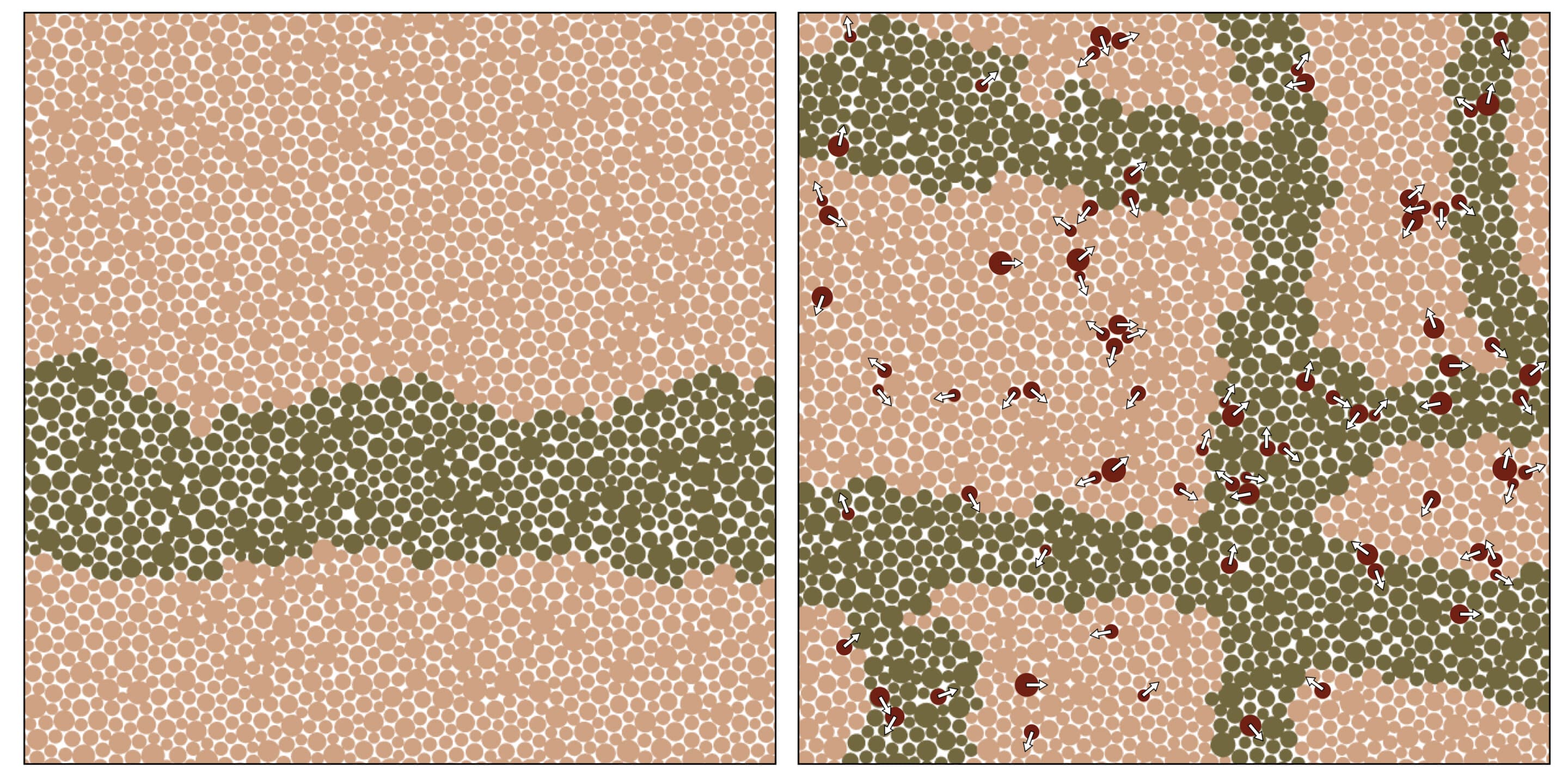
Researchers from the Tata Institute of Fundamental Research in Hyderabad and Heinrich Heine University in Düsseldorf report that introducing self-propelled particles into glass during shearing significantly reduces brittleness while allowing the material to withstand higher stress. In simulations, the self-propelled particles altered how the glass failed: instead of a single concentrated damage plane, deformation spread across a network of multiple fracture bands.
The mechanism depends on how long self-propelled particles move in one direction before reorienting, known as persistence time. When persistence time is short, particles rattle in place among neighbors, strengthening the glass and producing the network of fracture bands. With longer persistence time, particles can escape the cage formed by neighbors, making the glass easier to deform.
The researchers found an equivalence between how quickly glass is sheared and the strength of active forces from the particles. A rapidly sheared glass with weak activity behaves mechanically like a slowly sheared glass with strong activity. This relationship holds under creep conditions as well, where particles with greater activity delay flow and lower deformation rates.
The work is computational. Researchers identified dense colloidal systems doped with photoswitchable active particles as promising candidates for laboratory testing, though current experimental methods are largely limited to gels and colloidal suspensions rather than dense solid glasses.