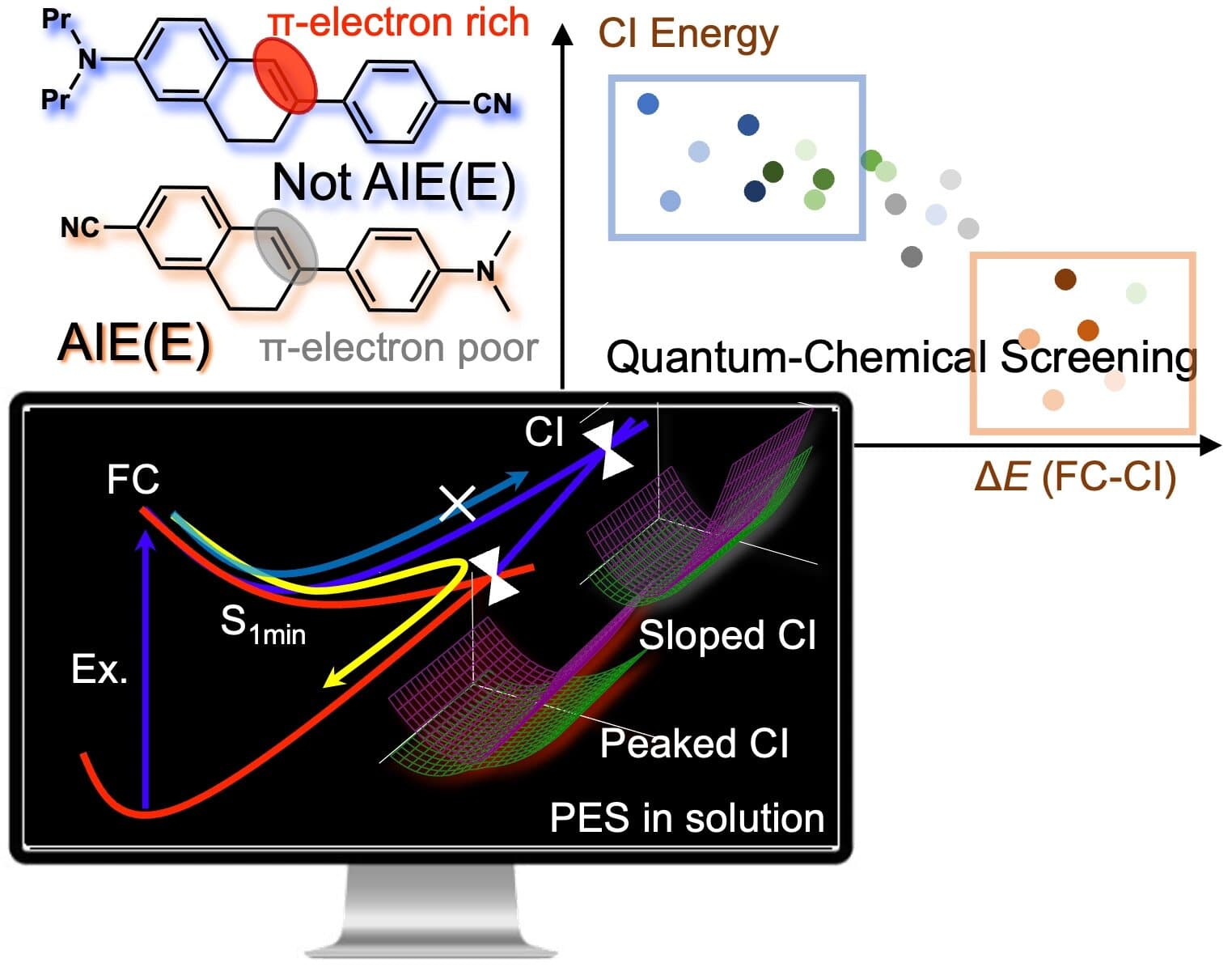
Researchers at Institute of Science Tokyo have identified how minor molecular substitutions control whether certain chemical compounds emit light in solid form, potentially streamlining the design of materials for light-emitting displays and biomedical sensors.
Aggregation-induced emission luminogens, or AIEgens, behave unusually: they emit weakly in dilute solution but become strongly luminescent when molecules aggregate or form solids. This trait makes them valuable for organic light-emitting diodes, microbial sensors, bioimaging and photodynamic therapy. However, predicting which molecular structures exhibit this behavior has historically relied on trial-and-error rather than rational design, the researchers noted.
Associate Professor Gen-ichi Konishi and his team found that the positioning of donor and acceptor groups on molecules fundamentally determines their excited-state potential energy surface and thus their light-emission properties. The team performed quantum chemical analyses on 30 stilbene derivatives to map how bridge size and chemical substitution positions affected the accessibility of conical intersections—regions where excited molecules rapidly lose energy without emitting light. The calculations identified a small number of energetic descriptors that could predict light-emission behavior.
The researchers then synthesized four bridged stilbenes based on their computational predictions and confirmed their photophysical properties matched the forecasted results. Ultrafast spectroscopy and topology analysis further showed that the arrangement of donor and acceptor groups controls how efficiently excited molecules undergo nonradiative deactivation.
"This work represents a significant shift in luminescent material design, moving from empirical trial and error toward rational, computation-guided molecular exploration," Konishi said. The findings, published in Advanced Science, could guide development of higher-efficiency OLED materials, fluorescent probes for bioimaging and sensing materials, he added.