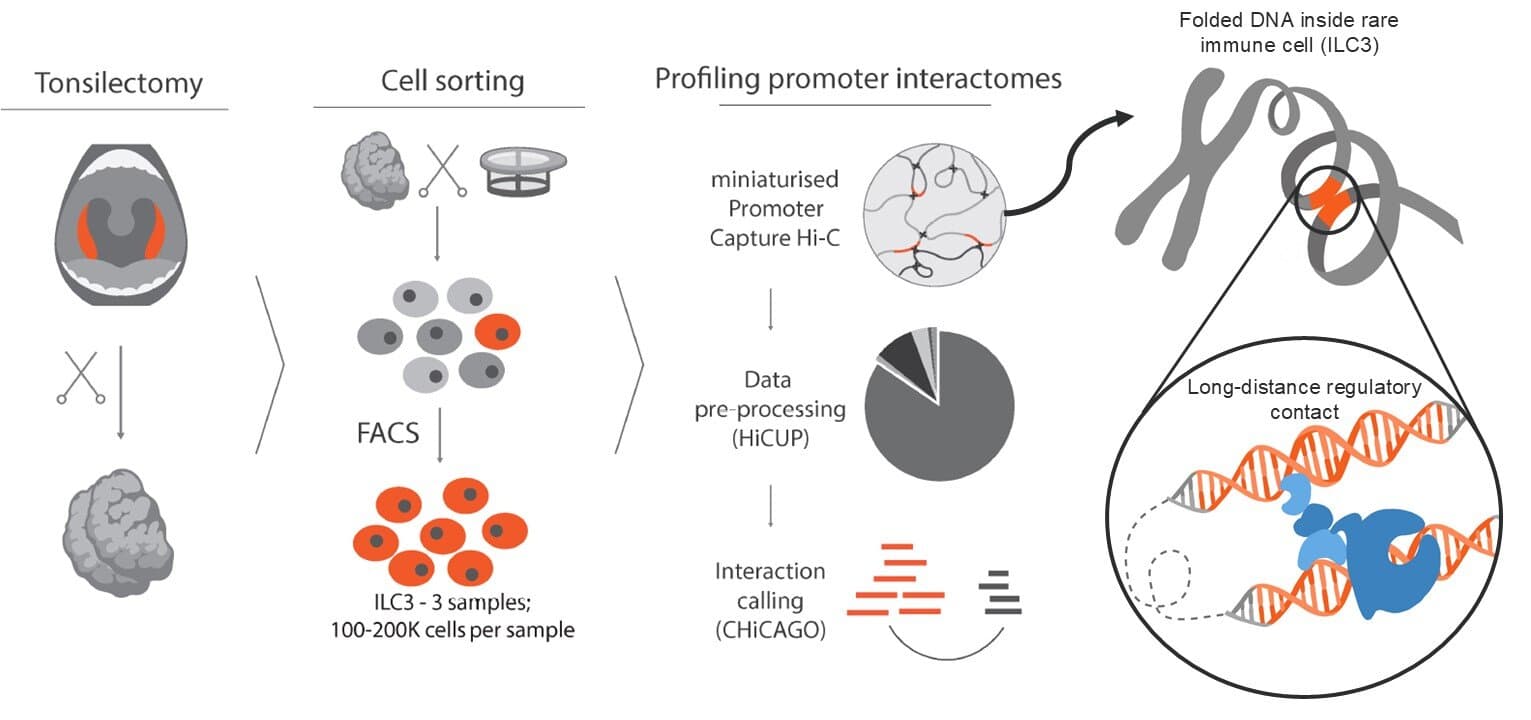
Genetic variants linked to disease often influence genes located far away along the DNA sequence rather than nearby genes, because DNA folds inside the cell to bring distant regions into physical contact. Capturing these long-distance regulatory connections has been especially difficult in rare immune cells, making it challenging to link genetic risk to the genes and biological mechanisms that drive disease.
A study co-led by researchers at Cincinnati Children's and MRC Laboratory of Medical Sciences in London, published in Nature Genetics, applies a new genomic approach to address this challenge in type 3 innate lymphoid cells (ILC3s), uncovering previously hidden connections relevant to autoimmune disease. ILC3s are tissue-resident immune cells that play a central role in maintaining barrier integrity and regulating inflammation, particularly in the gut, but are difficult to study at scale because they are rare and do not replicate well outside the body.
Most existing methods for mapping genome organization require millions of cells, restricting analyses to abundant or mixed cell populations. The new study overcomes this limitation using an optimized promoter capture Hi-C method that works with far fewer cells, allowing researchers to examine how DNA is folded in human ILC3s and how gene promoters physically interact with distant regulatory elements across the genome.
The researchers combined their three-dimensional interaction maps with large genome-wide association studies to connect DNA folding patterns to disease risk. This approach prioritized more than 100 candidate genes linked to Crohn's disease risk in ILC3s, many of which had not previously been associated with inflammatory bowel disease. One notable finding involved CLN3, a gene whose mutations cause Batten disease, a rare neurodegenerative disorder. Mouse models showed that when ILC3 cells are activated, Cln3 expression decreases, while increasing Cln3 levels reduced inflammatory gene activity and cytokine production.
The findings do not establish CLN3 as a causal gene in inflammatory bowel disease but raise questions about how immune regulation and neurodevelopmental disease pathways may intersect. Researchers said the new tools enable the study of genetic regulation in rare cell types previously difficult to analyze.