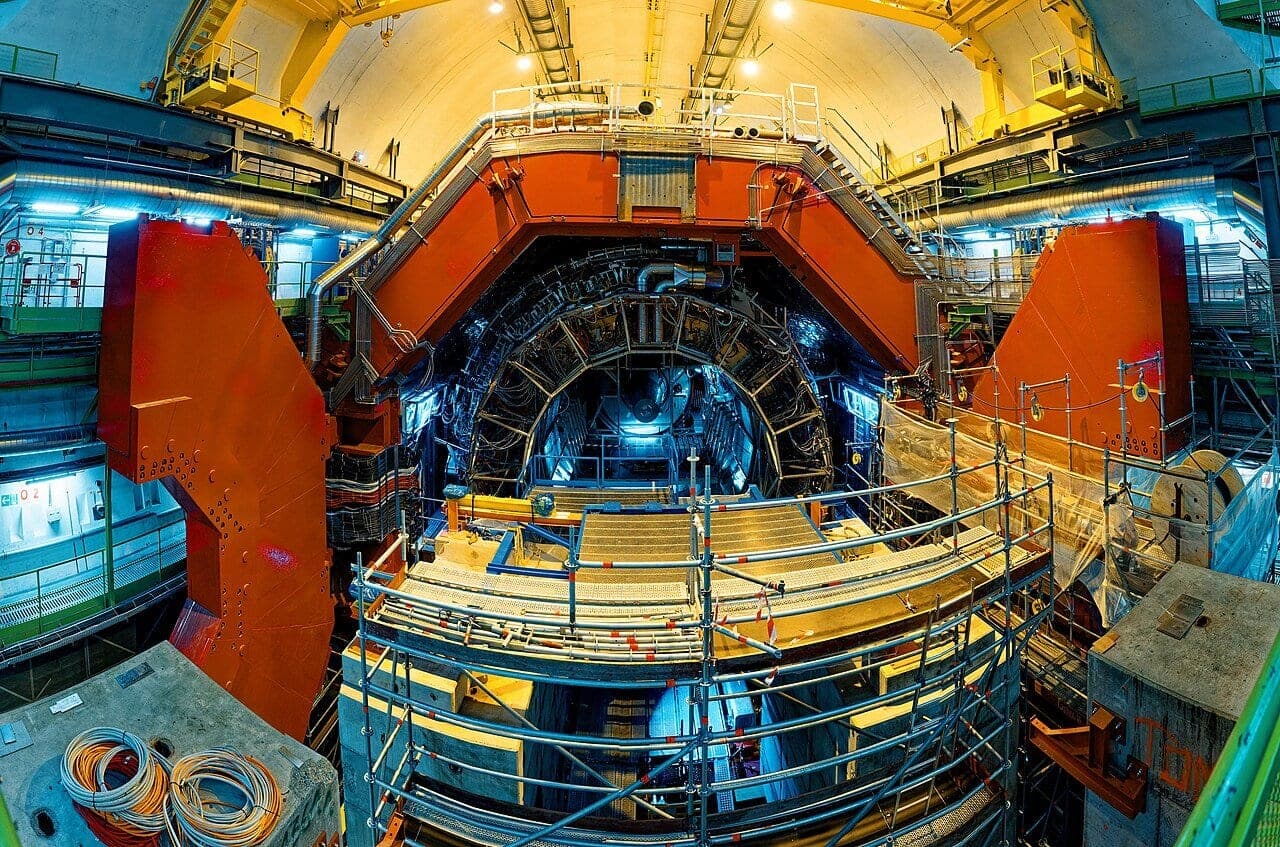
A University of Kansas physicist led a CERN study showing that competing theoretical explanations for gluon behavior inside atomic nuclei can now be experimentally distinguished. The research, carried out within the ALICE experiment at CERN's Large Hadron Collider and published in Physical Review Letters, reports the first multidimensional measurement of incoherent J/ψ photonuclear production across a range of interaction energies and momentum transfers.
The measurement provides scientists with a clearer view of how gluons—the particles that bind quarks together—are arranged inside atomic nuclei at high energies. Daniel Tapia Takaki, a nuclear physicist and professor at the University of Kansas, noted that understanding gluon behavior is essential to understanding how matter acquires its mass and structure, since gluons and the strong force carry nearly all the mass of the visible universe.
Takaki's team used incoherent J/ψ photonuclear production to study gluon fluctuations within nuclei with greater spatial resolution than previously possible. The measurements were performed using data from Run 2 of the Large Hadron Collider, where fast-moving lead nuclei passed close to one another without directly colliding, creating intense electromagnetic fields that behaved like beams of high-energy photons. When these photons struck another nucleus, they briefly produced a J/ψ particle, whose production revealed underlying gluon structure.
Researchers measured incoherent J/ψ production across photon-nucleus energies ranging from 20 to 633 billion electron volts while examining how the interaction changed with momentum transfer. At the smallest spatial scales explored, the production rate of J/ψ particles was significantly suppressed, with a statistical significance of about three standard deviations. This finding challenges the long-standing explanation known as nuclear shadowing, which has successfully described previous measurements.
The observations instead align with gluon saturation, a phenomenon predicted by quantum chromodynamics that describes the strong force. In this regime, gluons become so densely packed that they interact strongly with one another, limiting how many can exist in a given region. The new measurements indicate that conventional nuclear shadowing alone cannot fully explain the observed data.