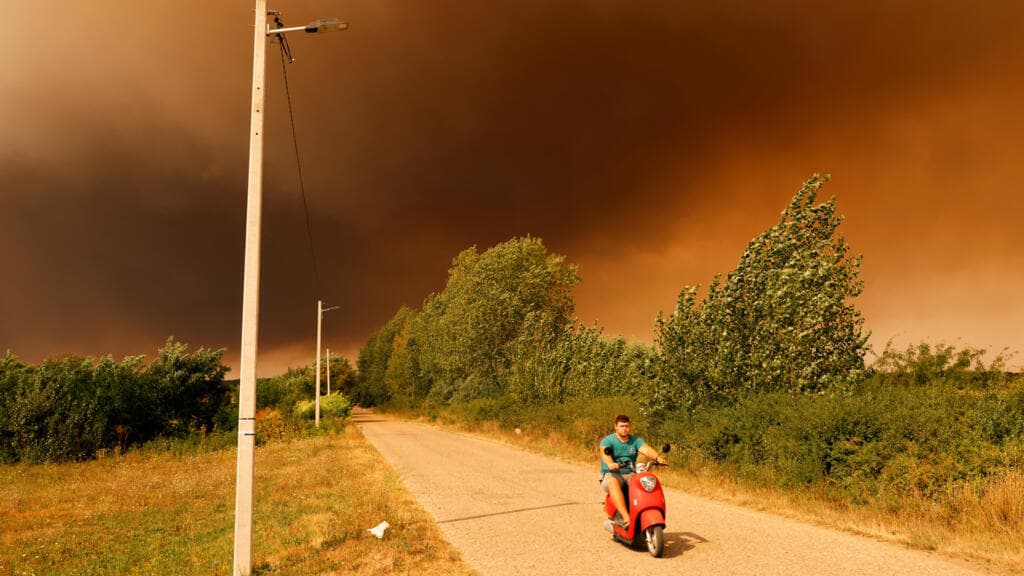
Wildfires and heatwaves risk reversing global air quality improvements and threatening human health, the World Meteorological Organisation said Monday. The UN weather and climate agency linked the deteriorating air quality to climate change, which scientists say is driving more frequent and intense fire and heat events.
Even as European and North American regulations have reduced industrial and transport emissions of PM2.5 particles, exposure to fire-related PM2.5 pollution has increased, the WMO said in its latest annual Air Quality and Climate Bulletin. "Extreme wildfires are increasing, leading to big health consequences because of the high toxicity of smoke," the agency stated.
Particulate matter smaller than 2.5 micrometres — emitted by wildfires, fossil fuels, farming and domestic heating — penetrates deep into the lungs and bloodstream. A study cited in the bulletin found extreme fire-smoke events have tripled globally since the 1990s, contributing to nearly 100,000 additional deaths annually between 2010 and 2018, though this may underestimate actual mortality.
The WMO said conventional air quality models may underestimate wildfire-related deaths by up to 93 percent because particles from burning vegetation are more toxic than those from other sources, even car exhaust. Lorenzo Labrador, from the WMO's Global Atmosphere Watch network, told AFP that fine particles from fires damage health far from their source as wind carries them over long distances.
Rising temperatures also increase ground-level ozone, which accumulates during heatwaves and has the potential to cause tens of thousands of additional premature deaths, the WMO warned. The agency called for better monitoring of aerosol particles, black carbon and microplastics, noting that these pollutants are "not sufficiently monitored even though they are widespread and potentially harmful to ecosystems." The WMO stressed that air quality and climate policies must be coordinated because "they cannot be dealt with in isolation."