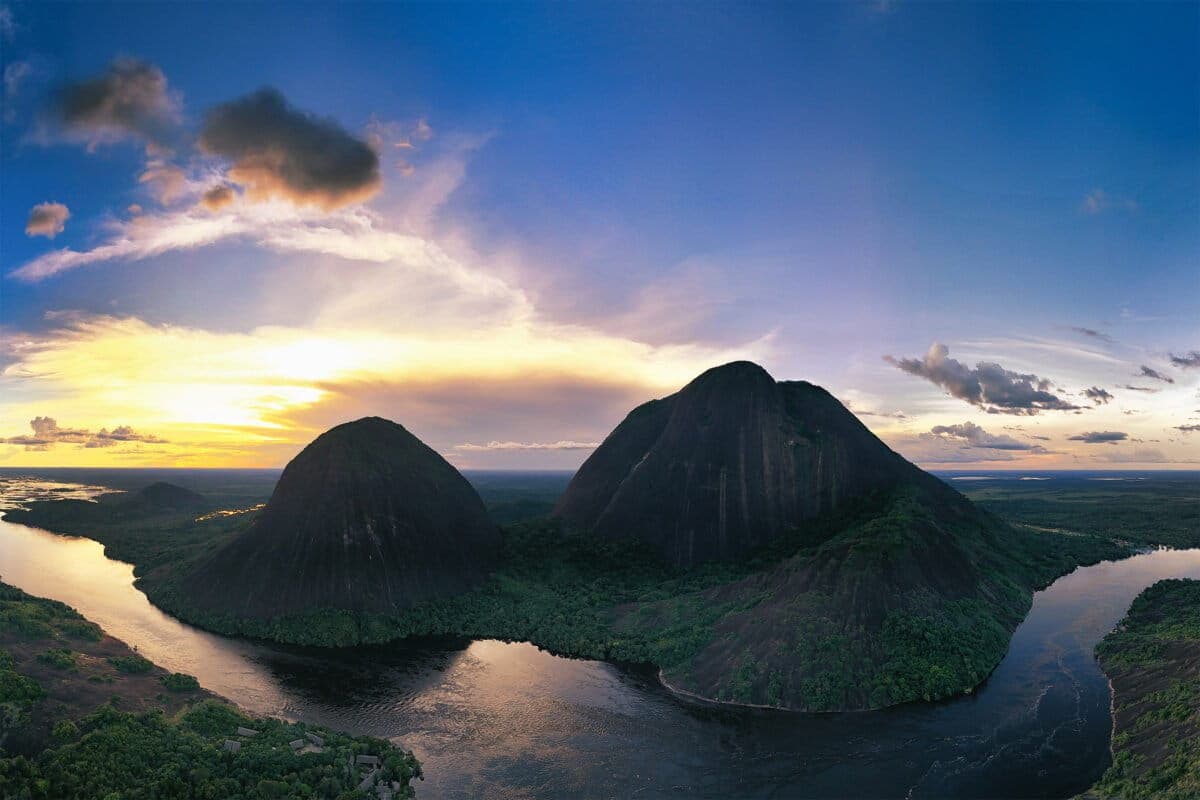
Three rock outcrops in Colombia's Guainía region are regarded as sacred by the Puinave, Cubeo, and other Indigenous peoples who inhabit the area. The Cerros de Mavicure, Mono, and Pajarito are part of the Guiana Shield and span two Indigenous territories: El Venado and El Remanso. In Puinave tradition, the hills are connected to creation stories, animals, family relationships, and rules governing interactions between people and the natural world.
The hills rise abruptly from the forest canopy above the Inírida River in eastern Colombia. Rivers serve as the main routes through the region, connecting communities, fishing grounds, and culturally significant sites. Travel by water illustrates how seasonal changes in river levels shape life in the area. Local residents said river levels were unusually high during a recent visit, near the upper end of what they could remember despite the flood season being typical timing for high water.
The area's approach to conservation reflects the authority of Indigenous communities. When the nearby Estrella Fluvial de Inírida Ramsar site was being planned, some Indigenous communities opposed proposed boundaries that overlapped their territories, concerned that outside designation could weaken their control over land they had long managed. The Cerros were ultimately excluded from the final Ramsar boundary.
Protection of the sacred hills now depends largely on Indigenous territorial governance, national forest-reserve rules, and community efforts to manage tourism. The waterways in the region face growing threats from illegal gold mining and associated mercury contamination. Local residents also noted that during the dry season, parts of the Inírida can narrow to about six meters, revealing white-sand beaches that attract visitors.