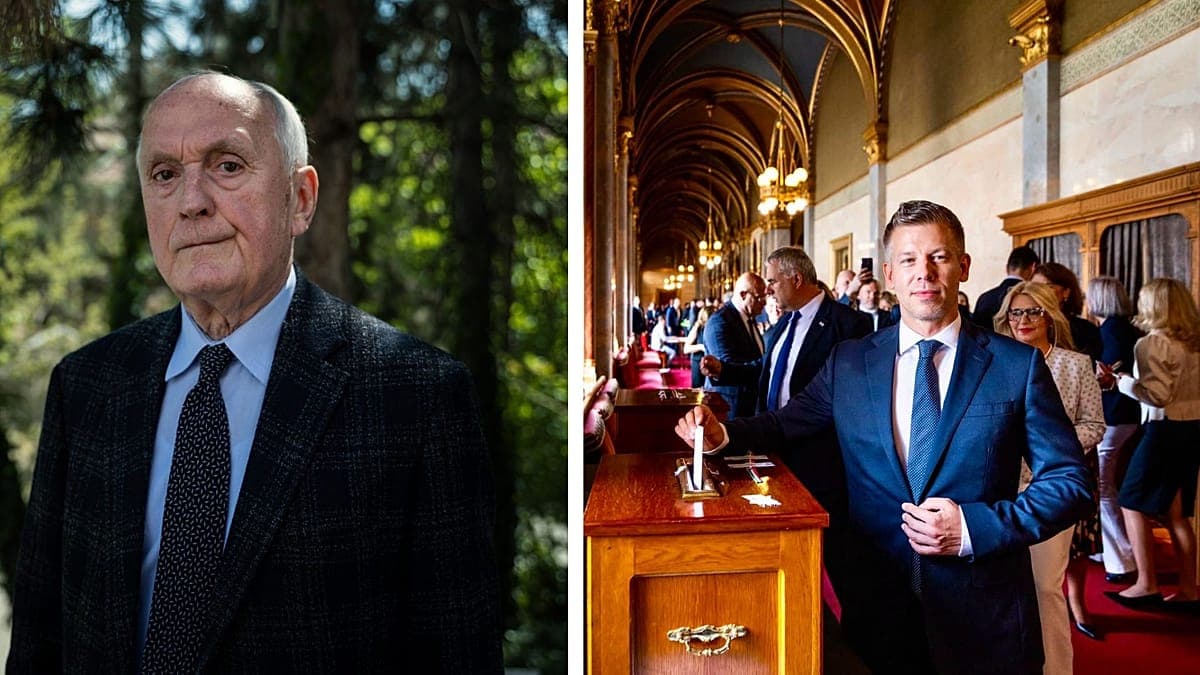
Hungary's parliament elected András Bakay, former head of the Supreme Court, as the country's president on Tuesday. Observers hope the move will strengthen confidence in reform efforts aimed at restoring the rule of law in the nation.
Bakay, a candidate from the ruling Tisza party which commands a two-thirds majority in parliament, received 140 votes, with 6 votes against and no abstentions. The 73-year-old president-elect will formally take office on 19 August.
In his first speech before parliament, Bakay said that "this nation has lost the equivalent of an entire generation, retreating from being a model of democratic transformation to becoming one of Europe's most backward countries." He added, "There is one thing certain: we cannot build a new Hungary on the basis of revenge."
Without naming particular parties or leaders, the president-elect spoke of political and economic injustice and deep divisions in Hungarian society, calling for investigations into breaches of law and accountability of perpetrators through proper and lawful legal procedures. He emphasised that the president must represent diversity and ensure the right to express opposing positions without using force to settle disputes.
Bakay reminded the parliament that the previous period had witnessed governance through decrees that bypassed parliament, causing checks and balances mechanisms to become non-functional, and stressed the importance of preventing such a recurrence. He also pointed out that the stability of any constitution derives from society's acceptance of it, calling for broad public and professional discussion to determine the boundaries of public power. He closed his speech by saying, "The state does not exist for itself, but for humanity."
Prime Minister Péter Magyar had previously offered the presidency to chess grandmaster Judit Polgar, but she declined to run. After consulting with over ten potential candidates, the Tisza party selected Bakay from three names through secret ballot.
Magyar, via Facebook, described the former judge as "worthy of representing the unity of the nation" and stated that his career was "an example to be followed in commitment to the rule of law."
In contrast, the Fidesz party led by Orbán boycotted the vote, calling it "illegal," after the new majority ended the tenure of previous president Tamás Sulyok before his term expired last month. The party reiterated its position before and after the vote, asserting that it still regards Sulyok as the legitimate president and will overturn this decision if it regains power, though this position is more political and symbolic than having direct practical impact.
In a victory speech delivered on election night on 12 April, Magyar announced his intention to dismiss senior state officials appointed by the previous government, including Sulyok. The Tisza government gave them 30 days to submit voluntary resignations, but Sulyok refused.
Ultimately, a parliamentary majority approved changes to the constitution that added provisions for ending a president's term, and Sulyok signed the law days after it passed in parliament, thus ending his term. According to Magyar, the new president is expected to serve only part of a full term, pending a process of constitutional rewriting estimated to take between one and one and a half years.
The Prime Minister said he would begin consultations on this matter next month.
Bakay worked as a judge at the European Court of Human Rights between 1991 and 2008, after being elected as a member of parliament representing the Conservative Democratic Forum party in 1990. He subsequently became head of Hungary's Supreme Court before being dismissed abruptly in 2012 after opposing a reduction in the mandatory retirement age for judges from 70 to 62 years, viewing the move as a "concealed purge" of the judiciary.
Four years later, the European Court of Human Rights concluded that his dismissal was driven by political motives. Non-governmental organisations, including Human Rights Watch, have criticised the dismissal, viewing it as based on methods similar to those used by former Prime Minister Viktor Orbán to reshape Hungary's institutions.
Bakay told the French news agency last month that the move should not have happened "in a country governed by the rule of law," and added that Hungary had become a "captured state" under Orbán.
Commenting on Bakay's inauguration, analyst Bulkso Ziga from the Fair political analysis centre said that Bakay "has done everything he could to prove that what happened to him violated European law." He added that Bakay's return sends a clear message to Hungary's European partners and at the same time gives confidence that the path to recovery of liberal democracy will be clear and well-defined.