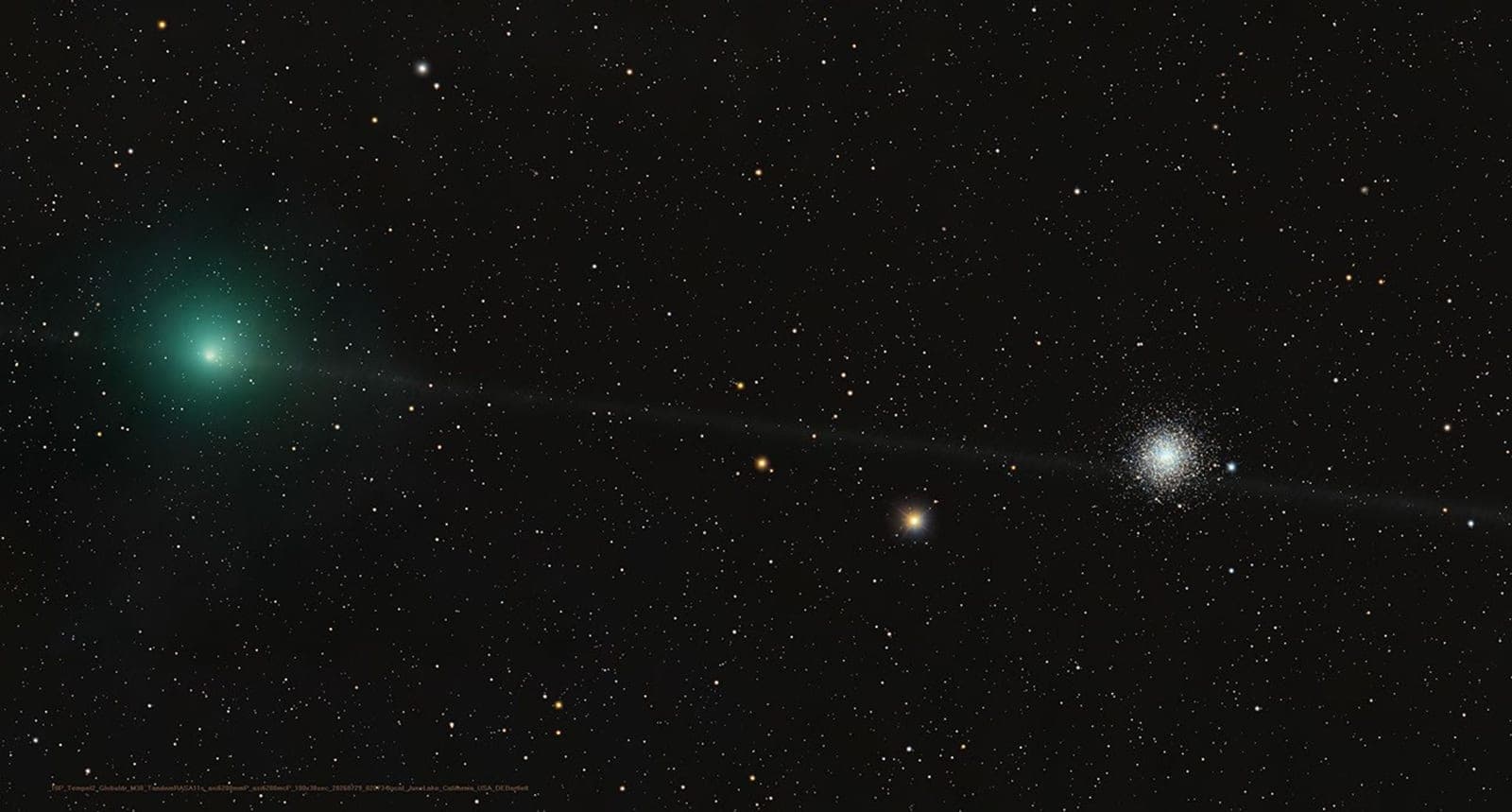
A modern telescopic image recorded on July 29 shows periodic comet 10P/Tempel 2 appearing to sweep close to the globular star cluster Messier 30, or M30, in the night sky. Though their proximity in the image appears striking, the two objects are separated by vast distances — Tempel 2 was approximately 3.5 light-minutes away, while Messier 30 is roughly 28,000 light-years distant.
Messier 30 is the 30th entry in astronomer Charles Messier's famous 18th-century catalog of nebulae and star clusters. Messier compiled his list to identify objects that remained fixed against the background stars, distinguishing them from the comets he was actively hunting. Objects in his catalog, unlike comets, did not shift position from night to night relative to the stars.
The comet's faint, narrow orbital dust trail appears to pierce the globular star cluster in the image. Had Messier himself observed this alignment with his period telescope, both objects would have appeared as similar faint and fuzzy objects in his field of view, though modern instrumentation makes their differences clear. Tempel 2 displays a diffuse greenish coma characteristic of comets.