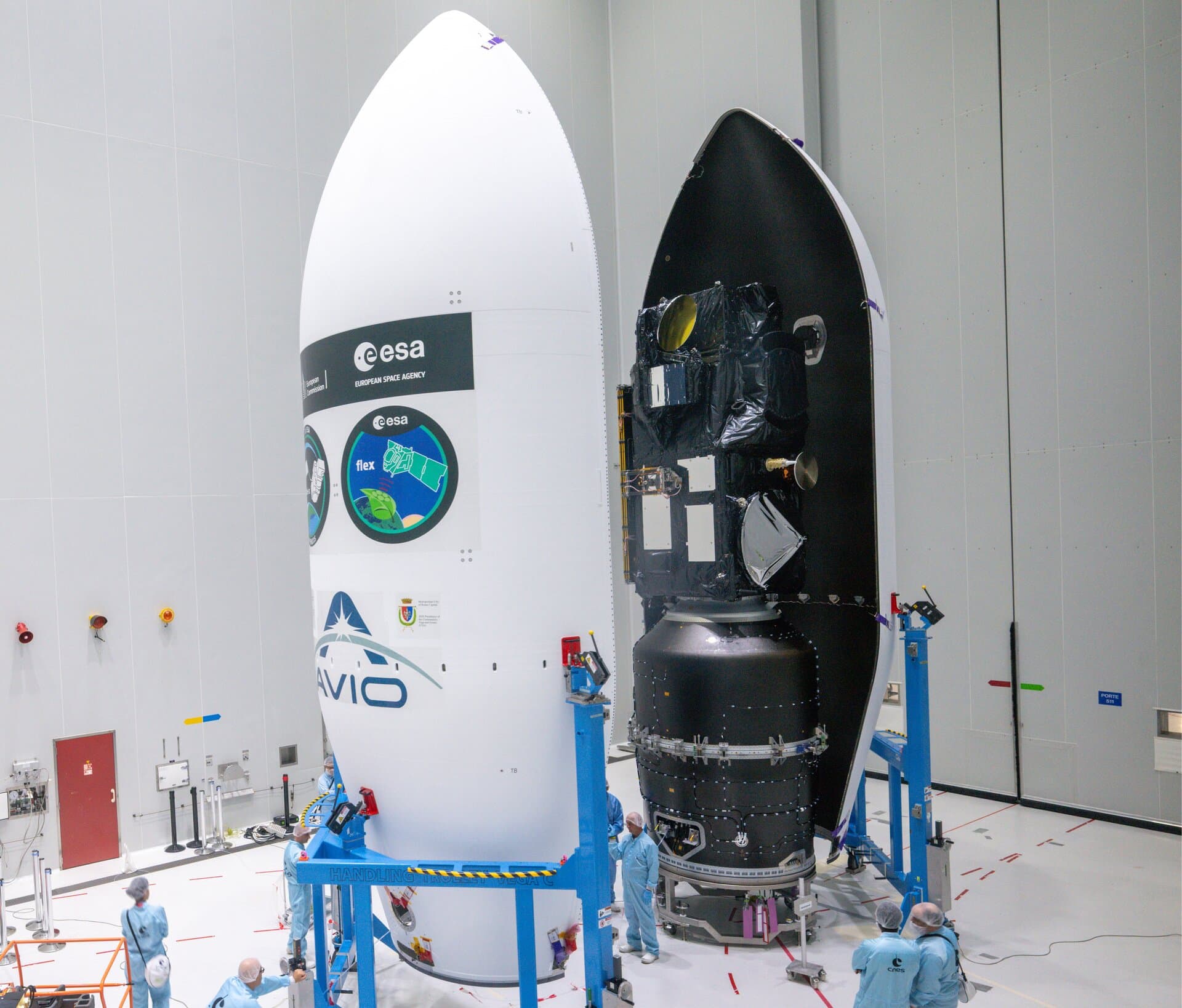
At Europe's Spaceport in French Guiana, the FLEX and Copernicus Sentinel-3C satellites have been enclosed within the protective fairing of their Vega-C rocket. The encapsulation follows more than six weeks of preparations at the spaceport and marks a significant transition in the launch campaign.
FLEX was positioned within the lower part of the Vespa secondary payload adapter, which allows the rocket to carry multiple satellites on a single launch. Sentinel-3C was then mated to the upper part of Vespa, positioning it for first deployment. The two halves of the Vega-C rocket's fairing were then brought together and sealed, with the fairing providing a protective shell against the acoustic environment, vibrations and aerodynamic forces during launch.
FLEX, the Fluorescence Explorer, is designed to detect the faint fluorescence emitted by plants as they photosynthesise. Equipped with a Fluorescence Imaging Spectrometer, FLEX will measure this signal from orbit to provide information about photosynthetic activity and vegetation stress on a global scale. The mission is expected to produce global maps of vegetation fluorescence at a resolution of 300 × 300 metres.
Copernicus Sentinel-3C, the third satellite in the Sentinel-3 series, will continue systematic monitoring of Earth's oceans, land, ice and atmosphere. Its instruments will measure sea-surface temperature, ocean colour, sea level and sea-ice characteristics, and will support monitoring of vegetation, wildfires and variations in inland water and ice-sheet heights.
Liftoff is scheduled for 15 September at 03:21 CEST. The next major step will see the encapsulated fairing hoisted atop the Vega-C rocket at the launch pad. ESA leads the Vega-C programme, with Avio serving as prime contractor, design authority and launch service operator for this mission.