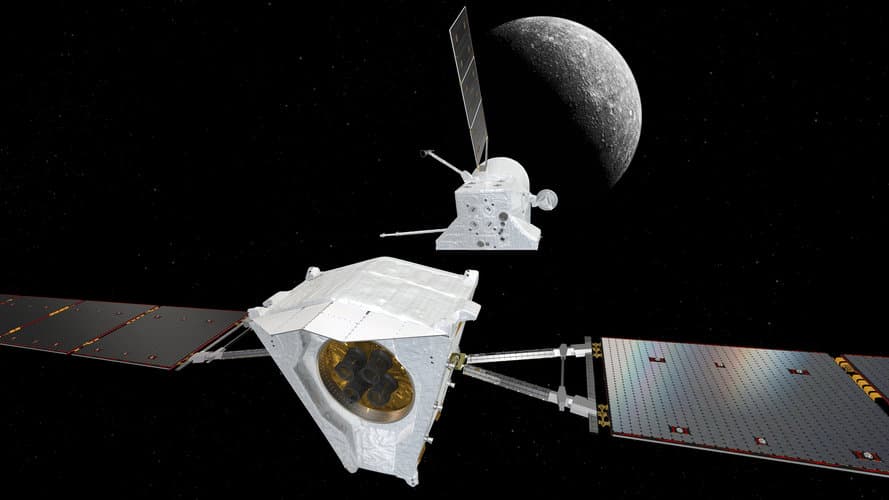
BepiColombo, a joint mission of the European Space Agency and Japan Aerospace Exploration Agency, successfully separated its Mercury Transfer Module from the spacecraft stack on September 3, 2026, after eight years travelling through the inner Solar System. The European Space Operations Centre confirmed the separation through Doppler signal detection and acquisition of signal via deep space antennas in Cebreros, Spain, and Malargüe, Argentina.
The separation represents a critical milestone for the mission, which aims to be the first to orbit Mercury with two spacecraft simultaneously. The European Space Agency's Mercury Planetary Orbiter and the Japan Aerospace Exploration Agency's Mercury Magnetospheric Orbiter will now proceed toward orbit insertion around Mercury on November 21, 2026, with separation from each other scheduled for December 9-10, 2026.
Executing the separation more than 200 million kilometres from Earth required precise planning, navigation and commanding with no opportunity for real-time intervention, according to mission officials. The composite spacecraft's systems were reported to be nominal, with the Mercury Planetary Orbiter's solar panels charging the spacecraft's batteries.
The mission's science phase is scheduled to begin in April 2027. The two orbiters will conduct observations and measurements of Mercury's magnetosphere, surface, and interior composition.