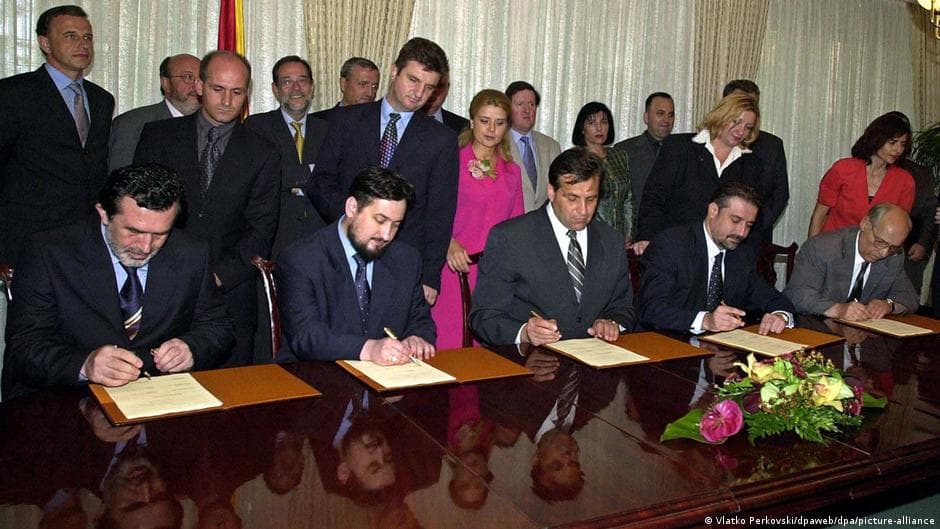
A six-month conflict that erupted in February 2001 in North Macedonia ended with the Ohrid Framework Agreement, a political compromise brokered by NATO, the United States and leading European Union countries. The fighting claimed the lives of 72 soldiers and police officers, while estimates of ethnic Albanian insurgent casualties range from about 100 to several hundred. More than 170,000 people were displaced.
The agreement reshaped North Macedonia's political system by introducing power-sharing mechanisms designed to give minority communities greater voice in decision-making. Laws affecting sensitive issues such as language, education and national symbols require support from both a parliamentary majority and representatives of minority groups. However, analysts say ethnic Macedonians and Albanians, who make up over a quarter of the country's 1.8 million population, live in peace yet genuine reconciliation remains unattained.
A change in governing arrangements has raised new questions about the agreement's future. The conservative Macedonian VMRO-DPMNE party returned to power two years ago, ending two decades of governing influence for the Democratic Union for Integration (DUI), the main ethnic Albanian party. Ali Ahmeti, who transformed himself from leader of the ethnic Albanian National Liberation Army during the 2001 conflict into a senior political figure, now argues that ethnic relations have deteriorated. He cited attacks on the official use of the Albanian language and the weakening of mechanisms designed to prevent majoritarian rule as "serious signals" about the country's direction.
Bujar Osmani, a senior DUI official and former foreign minister, said the key question is no longer how much of the Ohrid Agreement has been implemented, but whether its gains can be preserved. He said: "Ohrid is not an administrative checklist that can be fulfilled once and then archived. It is a system of balance that must be respected continuously." Meanwhile, ethnic Macedonian figures such as police general Stojance Angelov argue that affirmative representation policies have created unfair advantages for Albanians in public sector recruitment.
International observers warn that years of political crises have slowed reforms and reinforced ethnic divisions. Harald Schenker of the German peacebuilding organization Pro Peace said the agreement transformed North Macedonia's institutions but not necessarily relations between its communities. He noted that ethnic distance is increasing, the education system remains segregated, and the two communities understand each other less and less. Years of stalled EU integration have further fueled uncertainty about the country's direction, with North Macedonia still awaiting the formal opening of EU accession negotiations despite becoming a candidate country in 2005.