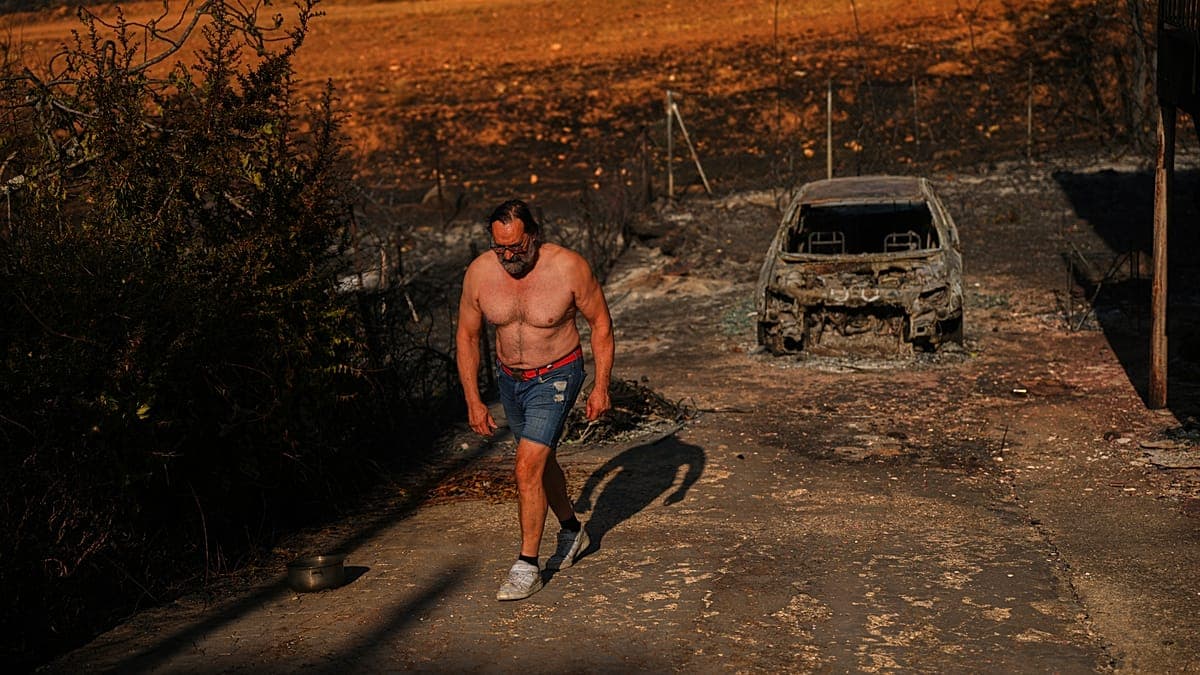
Europe is facing a series of widespread forest fires this summer. In Spain and France alone, more than 320,000 people have been evacuated by the end of July. Forest fires continue as heat waves expand towards mid-August.
Calculating the cost of forest fires is a complex process; the area of burned land is easy to measure, but the economic impact and other consequences require greater effort. Professor Simone Varetto from Henley Business School at the University of Reading said that "forest fires in Europe this year ensure that the economic cost far exceeds mere rehabilitation of burned land".
Varetto added that "the final bill will include destroyed homes and businesses and crops, disrupted tourism and industry, health impacts from smoke, additional pressure on public finances, and the possibility of rising insurance premiums". Nevertheless, the area of burned land remains a key indicator of the scale of forest fires and the potential impacts they can have.
By early August, 2026 ranks fourth in the European Union in terms of cumulative burned land area from forest fires, according to the Our World in Data platform, which relies on the Global Wildfire Information System. By week 31, forest fires had consumed 489,826 hectares in the European Union, the highest figure after 2012 (863,122 hectares), 2022 (799,040 hectares), and 2017 (743,906 hectares).
The 14-year average between 2012 and 2025 reached 434,711 hectares in the European Union, while 2026 exceeds this average by 55,115 hectares, or an increase of 13 per cent. All these figures are compared at the same point in those years, namely the end of week 31.
Varetto noted that European fires primarily strike forests, scrubland, grassland, and agricultural land, with some fires spreading to towns and surrounding areas. Spain is the European Union country most affected by forest fires in terms of burned land area. By early August 2026, the year has seen 185,948 hectares burn, equivalent to 38 per cent of the total burned area in the European Union.
Between 2012 and 2025, the average burned land area in Spain by week 31 of each year reached 85,626 hectares. In 2026, that figure reached more than twice this average. By week 31, 2026 became the third worst year in Spain in terms of cumulative burned land area from forest fires since 2012, when this comparative data began. Spain lost 258,340 hectares in 2022 and 211,350 hectares in 2012.
France ranks second, with 99,092 hectares burned during this period, representing 20 per cent of the European Union total. The 14-year average in France is 31,648 hectares, while 2026's figure exceeds this average by more than threefold. 2026 is the worst year for France since 2012; the country lost 86,888 hectares to forest fires in 2019, the second highest figure on record.
By early August 2026, Italy (79,084 hectares), Portugal (47,776 hectares), and Greece (23,839 hectares) were also severely affected by forest fires. For Italy, 2026 is the fifth worst year in the last 15 years in terms of burned land area from forest fires, and the same applies to Portugal. In Greece, 2026 is relatively less severe; the country recorded larger burned areas from forest fires in several previous years.
Although the cumulative burned land area appears relatively lower, some countries recorded significant increases in 2026 compared with their 14-year average. For example, Austria lost 1,687 hectares this year by early August, compared with an average of 513 hectares. Denmark lost 1,177 hectares compared with an average of 404 hectares, Germany 6,045 hectares compared with 3,098 hectares, while the Netherlands lost 1,677 hectares compared with an average of 352 hectares.
This also applies to the United Kingdom, which lost 22,206 hectares compared with an average of 12,311 hectares. 2026 is the most affected year not only for the United Kingdom, but also for several other European countries over the last 15 years, although these figures only cover what occurred by early August.
By contrast, Turkey experienced far fewer forest fires this year; the country has lost 39,556 hectares so far, compared with an average of 134,707 hectares. Varetto warned UK authorities, arguing that the United Kingdom should treat what happened in southern Europe as an early warning. He said that "these summer heat waves and forest fires in southern England, which have burned more than 20,000 hectares, show that fire risk is no longer confined to the Mediterranean region".