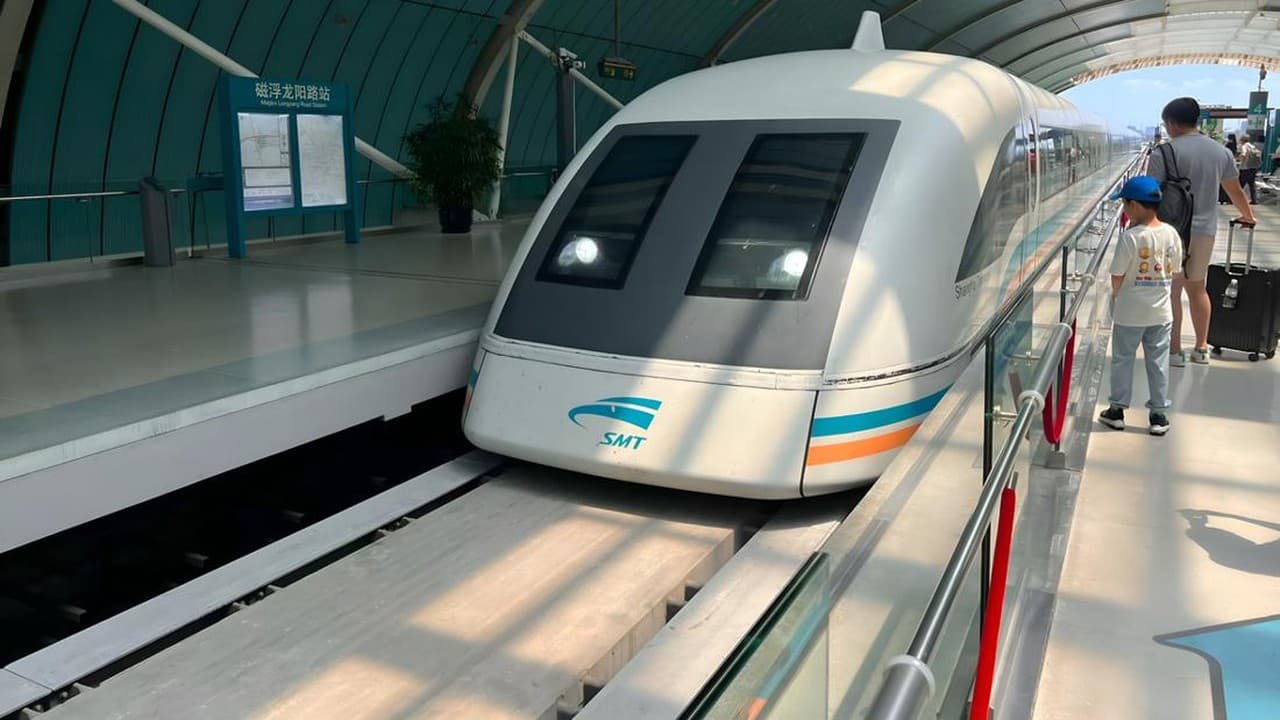
An experimental train made by China has successfully broken a new world record in short-distance acceleration. The train reached a speed of 800 kilometres per hour from a standstill in just 5.3 seconds, a speed that nearly matches the cruising speed of a commercial aircraft.
The test was conducted on a one-kilometre test track at the East Lake High-Speed Railway Laboratory, Hubei Province, China, according to IFL Science on Thursday (13 August). This is the third time the East Lake laboratory has successfully broken a world record on the test track. The laboratory previously stated its ambition to develop a magnetic levitation train capable of reaching speeds of up to 1,000 kilometres per hour.
This super-speed train system utilises magnetic levitation to hover smoothly above the rail, eliminating mechanical friction and allowing for smoother and faster travel. The train track is lined with electromagnets whose magnetic poles can switch according to electrical current. The combination of pulling force from the front and pushing force from the back moves the train continuously like a wave, with speed controllable through adjusting the rate of change of the electromagnetic poles.
Experts from China have demonstrated that the train not only reaches extreme speeds but can also be stopped in a controlled manner using its braking system. After reaching 800 kilometres per hour, the train can come to a smooth and gradual stop over a distance of approximately 200 metres. Researchers at the National Defense Technology University of China are also testing another super-high-speed maglev train, with one test recording acceleration of up to 697 kilometres per hour in just two seconds.
Although the technology is not currently intended to carry passengers, researchers hope its basic principles can be applied to rocket launch systems and military aircraft. China is also developing similar super-high-speed maglev technology to operate inside low-pressure tubes or vacuum spaces, but this development still faces major challenges including high infrastructure costs, passenger safety factors, and the construction of high-precision multi-level rail tracks over long distances.