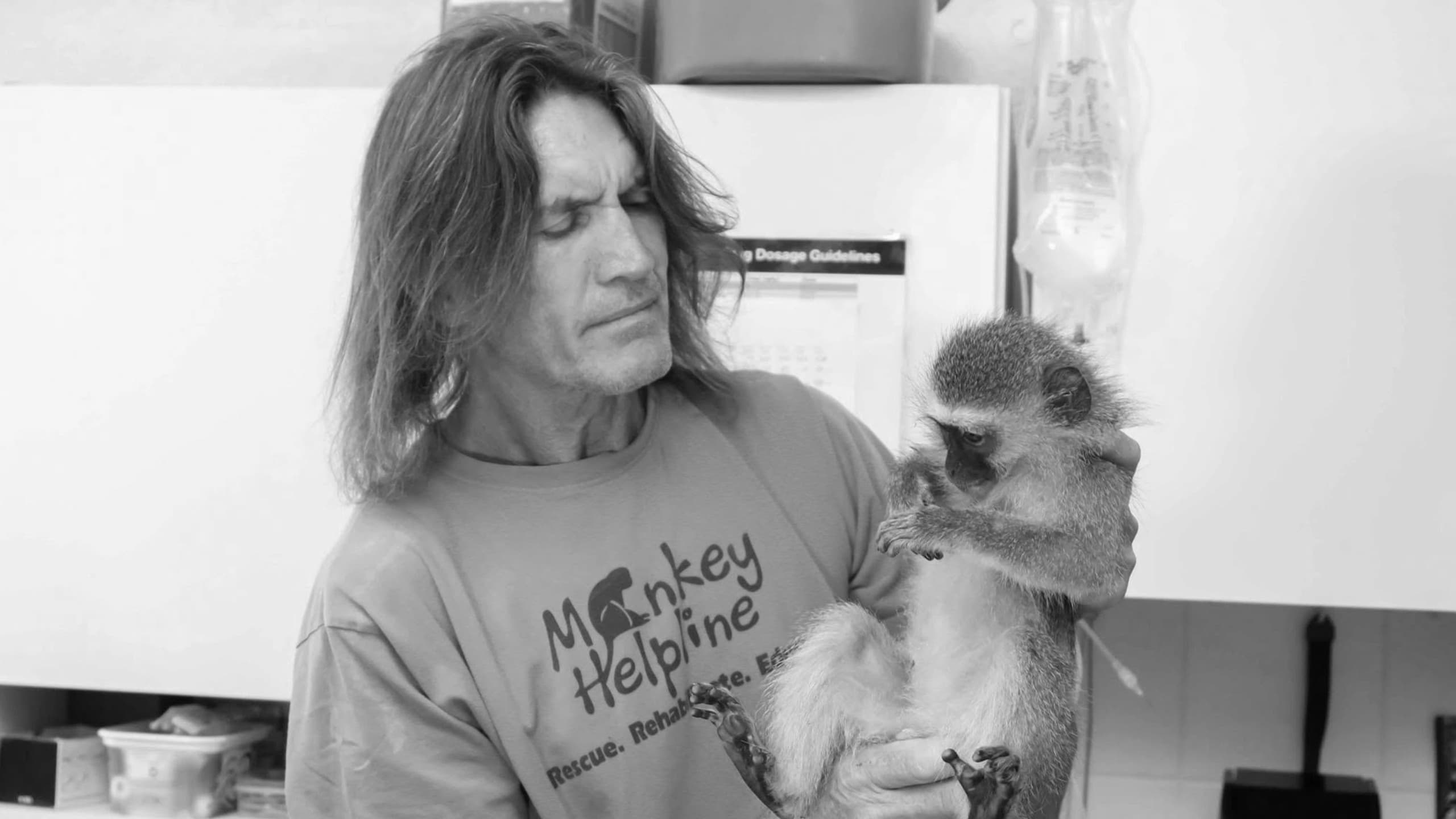
Steve Smit, known around KwaZulu-Natal as the "Monkey Man" for his work rescuing vervet monkeys, died on August 12th after a battle with cancer. He was 70. For three decades, Smit climbed trees, crossed roofs, crawled under buildings, and entered gardens to retrieve monkeys that had been shot, shocked on power lines, hit by cars, bitten by dogs, or caught in wire.
Before devoting himself to monkey rescue, Smit spent roughly 25 years in South Africa's intelligence services, including stints with the police, the Bureau of State Security, and the National Intelligence Service. In a 2007 oral-history interview, he recalled being troubled by the conduct and culture of some of the institutions where he worked. His involvement with animals began while still in government service. In 1985 he founded FALCON, the Front for Animal Liberation and Conservation of Nature, described as South Africa's first animal-rights organization, which later became Justice for Animals.
Smit campaigned against vivisection, recreational hunting, circuses, and wildlife trade, positions that often put him at odds with conservationists. He was concerned not only with whether a species would survive, but with what happened to individual animals. In a 2003 submission to Parliament, he argued that animals deserved protection regardless of whether their species was endangered or abundant. In 1995 FALCON helped bring about a public debate over elephant culling in Kruger National Park, after which the National Parks Board suspended culling.
Monkey Helpline, which he started in 1995, eventually became a full-time, unpaid occupation for both Smit and his partner Carol Booth. On an ordinary day Smit might respond to several calls; on a bad day, as many as ten. Some rescues required as much diplomacy as physical effort, as vervet monkeys living near people often produced conflict. Smit spent countless hours explaining to nervous homeowners that the animals were neither rabid nor likely to attack them, pointing out that human settlement had expanded into their habitat.
The work consumed much of his money, and Smit drew no salary from Monkey Helpline. During a serious illness in 2021, he had no medical aid, but remained preoccupied with his causes while in hospital. In 2015 he suffered a badly injured right eye while rounding up rescued chickens in his garden near Durban, an injury that nearly cost him his sight. Within weeks, wearing an eye patch, he had gone on more than 20 wildlife rescues.