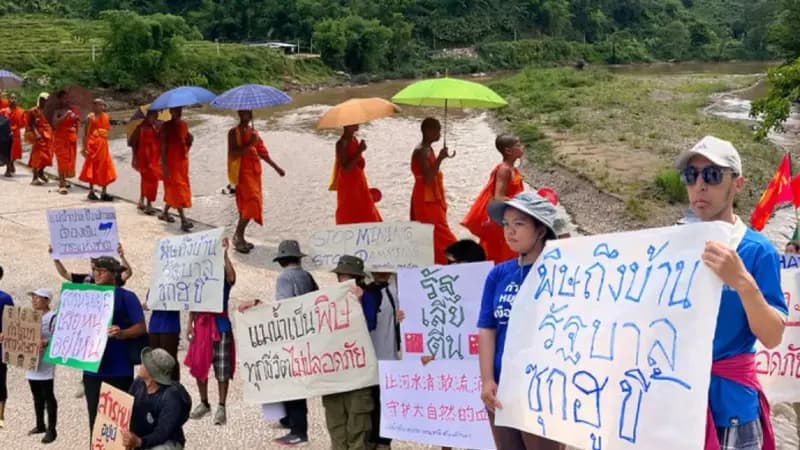
Hundreds of villagers, Indigenous leaders, environmental defenders, monks, and civil society activists completed a six-day peace walk in July along the Kok River in northern Thailand to demand action against water contamination. The river, which originates in Myanmar's Shan State and flows through Chiang Rai and Chiang Mai provinces before joining the Mekong River, provides drinking water, irrigation, fisheries, and transportation for communities along its banks.
Environmental groups and local communities have linked heavy metal contamination in the river to mining operations upstream in Myanmar, with reports of elevated concentrations of arsenic, lead, and other metals. According to the NGO Coordinating Committee on Development, turbidity along sections of the Thai-Myanmar border has increased dramatically, while arsenic and lead contamination have exceeded recommended safety levels in several communities. Public health authorities have advised caution regarding consumption of aquatic animals from contaminated rivers because of heavy metal exposure.
On July 6, members of the People's Network to Protect the Kok, Sai, Ruak, and Mekong Rivers marched toward the Chinese Consulate-General in Chiang Mai to deliver a petition urging China to regulate Chinese companies operating mines in Myanmar. Police blockaded the demonstrators, and a confrontation occurred when officers attempted to seize a protest banner, leaving two protesters injured—one with a broken arm and another with a dislocated shoulder. The protesters filed a police complaint alleging excessive use of force; police said officers acted in accordance with legal procedure.
For Indigenous communities in northern Thailand, protecting the Kok River is tied to preserving lands, livelihoods, and cultural heritage. Because the rivers cross national boundaries, downstream communities often bear the environmental consequences of activities occurring beyond Thailand's jurisdiction. Environmental advocates argue that stronger regional cooperation between Thailand, Myanmar, and China is necessary to investigate pollution sources, improve monitoring, and prevent further contamination.
Human rights organizations have documented increasing use of Strategic Lawsuits Against Public Participation against environmental activists in Thailand. Such lawsuits often impose significant financial and psychological burdens even when charges are eventually dismissed. Rights organizations argue that these cases discourage public participation and make it more difficult for affected communities to raise environmental concerns.