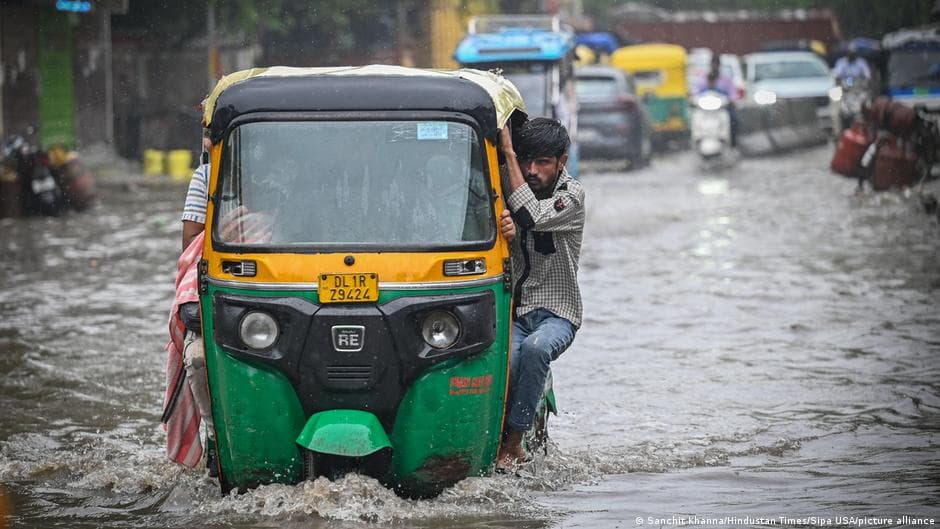
More than 100 people have died across India since late July as heavy monsoon rains triggered floods, landslides and lightning strikes. The northeastern state of Assam bore the heaviest toll, with more than 120,000 people affected by flooding, while Kerala, Jammu and Kashmir, Bihar and Jharkhand reported deaths and widespread disruption.
India's southwest monsoon has historically arrived around June and retreated by September, with a broad pattern predictable enough for farmers, cities and businesses to plan around. But the timing and intensity have become increasingly erratic. Rather than receiving more rain overall, the problem is that rain now arrives in longer dry spells interrupted by short bursts of intense rainfall that overwhelm rivers, drainage systems and hillsides, scientists said.
Madhavan Nair Rajeevan, a climate scientist and former secretary in the Ministry of Earth Sciences, said average seasonal rainfall has not shown systematic long-term change, but the timing, intensity and distribution have become noticeably different. "The characteristics of the Indian monsoon have changed fundamentally," he told DW. "We are witnessing an increase in short-duration rainfall extremes, longer dry spells, and changes in the frequency, intensity and distribution of monsoon weather systems." He said this represents a structural shift in the monsoon system beyond natural variability.
A warmer atmosphere can hold more moisture, making periods of intense rainfall more severe, according to Akshay Deoras, a senior research scientist with the UK's National Centre for Atmospheric Science and the University of Reading. Forecasting has improved, but authorities often fail to act on warnings with measures such as changing school schedules or restricting travel before heavy rain arrives, he said.
India's infrastructure remains largely designed around historical seasonal rainfall averages rather than the short, high-impact events now causing the greatest disruption, Deoras added. Cities are further strained by rapid construction that reduces land available to absorb water, while after weeks of dry weather, hard soil absorbs less water, causing more flooding when heavy rain finally arrives. Farmers depend heavily on the timing of rainfall, and both long dry spells and intense rain can disrupt sowing and damage crops.
Ritwick Dutta, an environmental lawyer and managing trustee of the Legal Initiative for Forest and Environment, said the problem extends beyond extreme weather itself. He noted that India's environmental clearance system does not require climate change to be systematically factored into project decisions, and that planning for cities such as Pune has not adequately incorporated climate projections despite government studies predicting a 37% increase in rainfall by 2030.
The Centre for Science and Environment found that extreme weather affected India on 331 of 334 monitored days in 2025, or 99% of the period assessed, with more than 4,000 people killed, about 3,000 during the monsoon. Sunita Narain, director general of the CSE, said adaptation must become part of the country's development strategy. "Climate change is no longer a future threat. It is already here in the form of extreme heat, extreme rainfall and increasingly destructive weather events," she told DW. "Cities, roads, drainage systems and water infrastructure can no longer be designed for yesterday's climate."