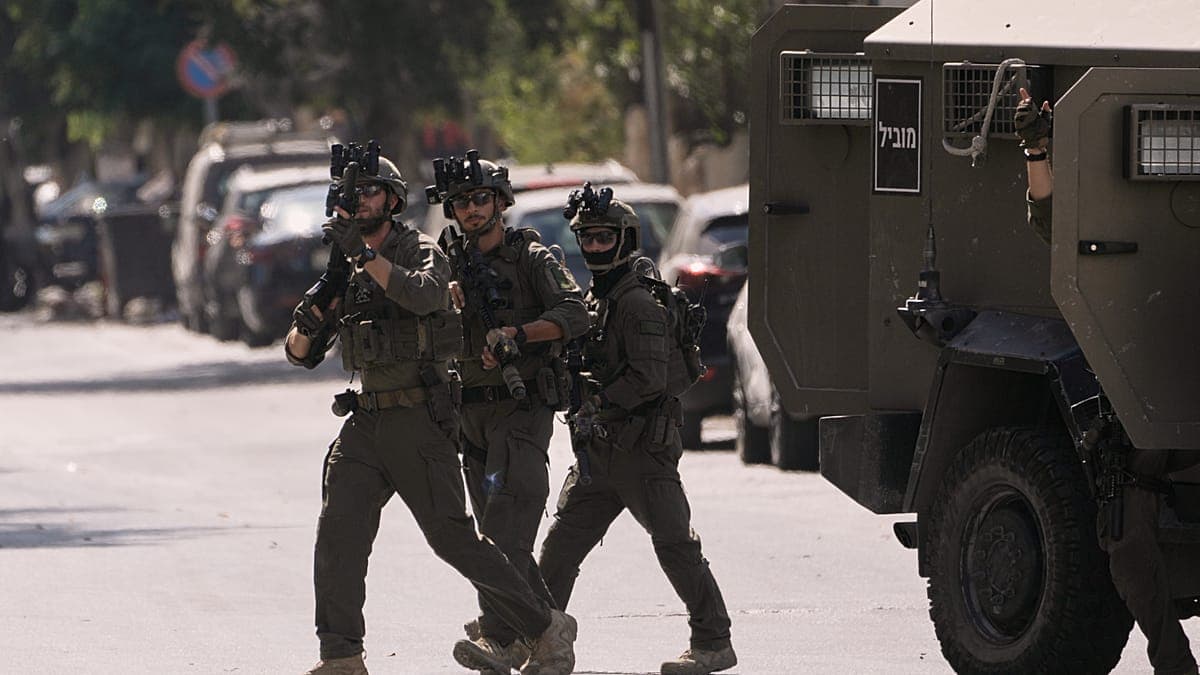
According to a Jerusalem Post report, there is broad agreement among Israeli senior defence officials from various ideological backgrounds on the need to maintain security zones in Gaza, Lebanon and Syria for years to come, despite recent agreements with Hamas and the Lebanese government as well as US pressure on Israel to withdraw more forces.
Views are divided on the extent to which Israel responds to US requests. In Gaza specifically, a majority of defence officials support giving the Palestinian Authority a role in managing the territory in place of Hamas, and have criticised Prime Minister Benjamin Netanyahu for obstructing this path. Meanwhile, a minority supports Netanyahu's maintaining a "National Committee for Managing Gaza," arguing this as a way to maintain pressure on figures associated with the Palestinian Authority and keep them within the framework of the US "Peace Council."
According to the report, Israeli defence bodies do not rely heavily on the Palestinian Authority's or national committee's ability to fully expel Hamas from its military positions, but they view this as not preventing the expansion of either's role in managing the territory, even if disarming the movement takes a long time or is only partial.
Regarding troop withdrawal, a minority prefer to retain as much of Gaza as possible, while a majority have shown readiness to reduce the scope of Israeli military presence, on condition that they retain high-ground positions and points that give the army field advantage. This approach could mean maintaining deeper presence near Shuja'iyya, but reducing deployment in Rafah, where Israel could control a smaller area while retaining observation capabilities, according to Israeli estimates. The same applies to highlands in the northern part of the territory extending towards Beit Hanoun.
Thus, the proportion of land remaining under Israeli control is not a determining factor, but defence bodies maintain positions they consider strategic. Even if Hamas offers partial concessions, Israeli officials are prepared to respond with limited withdrawal, while insisting on long-term buffer zones.
A similar approach partly applies in Lebanon. According to the report, a majority of defence officials do not see a need to control large areas of Lebanese territory, but at the same time they do not show great confidence in the Lebanese army's ability to confront Hezbollah. Even among supporters of reducing Israeli deployment, there is doubt that handing control of "pilot" areas to the Lebanese army will produce fundamental security change.
Officials are divided on the extent to which diplomatic openness between Beirut and Tel Aviv will affect the Hezbollah issue. While one group believes Beirut's cooperation could help limit the group's capabilities, another sees the Lebanese government's influence as limited and therefore unreliable in formulating long-term security strategy.
Aligned with security zones, officials agree on the need to continue the "wars between wars" strategy, namely carrying out periodic strikes—or what is known militarily as a "mowing the grass" strategy—to prevent Israel's opponents from rebuilding military capabilities or developing new strategic threats, according to the report. However, disagreement centres on the tempo and limits of these operations, particularly when Washington believes that de-escalation serves diplomatic channels.
One group fears that halting strikes could make their resumption later more difficult, while another prioritises maintaining US support, amid declining international support for Israel.
In Syria, the position appears harder. There is hardly any mainstream current in defence bodies supporting broad Israeli withdrawal, despite recent US pressure, according to the report. Although there have been no recorded attacks from Syrian territory against Israel since Ahmad al-Sharaa took power in December 2024, Israeli officials remain suspicious of Syria's new leadership and believe that Damascus's reluctance to confront may be a tactical position related to not yet securing its control over the country.
The possibility of Syrian army reconstruction and the rebuilding of its heavy weapons stores also raises concerns in Tel Aviv, particularly given reports of possible Turkish involvement in rehabilitating some capabilities targeted by Israel after the fall of Bashar al-Assad's regime.
As for Iran, it emerges as the most complex dossier. The report conveys that a majority of defence officials believe Israel's strategic position is better after June 2025 operations compared with the situation following early 2026 operations. After the Israeli army spoke of weakening Iranian missiles and drones and Tehran's ability to rebuild its weapons stores, officials worry Iran will recover some of its deterrence capabilities, particularly amid the Strait of Hormuz crisis, as well as the possibility that Washington will limit new Israeli military action against the Islamic Republic.
They also believe Tehran has successfully reconnected its front lines with Hezbollah's front lines, after Israel succeeded in weakening this connection in 2025, and is exploiting recent months to repair some of its capabilities.
Consensus status does not extend to the future of Iran's nuclear programme. One group within defence bodies rejects any agreement that does not include Tehran abandoning uranium enrichment for years, while another believes that the position of US President Donald Trump's administration makes this condition unrealistic, and what is needed is to push for an agreement that reduces risk as much as possible.
According to this view, it is acceptable if Iran has a large number of centrifuges if its enriched uranium stockpile is near zero, or to allow limited low-level enrichment if the number of centrifuges is very small. The red line, according to the report, is preventing Tehran from combining large stockpiles of enriched uranium with a large number of centrifuges, while imposing a stricter inspection regime than the 2015 nuclear deal.
Simultaneously, defence officials are seeking mechanisms to control the reconstruction of Iran's ballistic missile arsenal, an issue they see as not being a sufficient priority for the Trump administration.