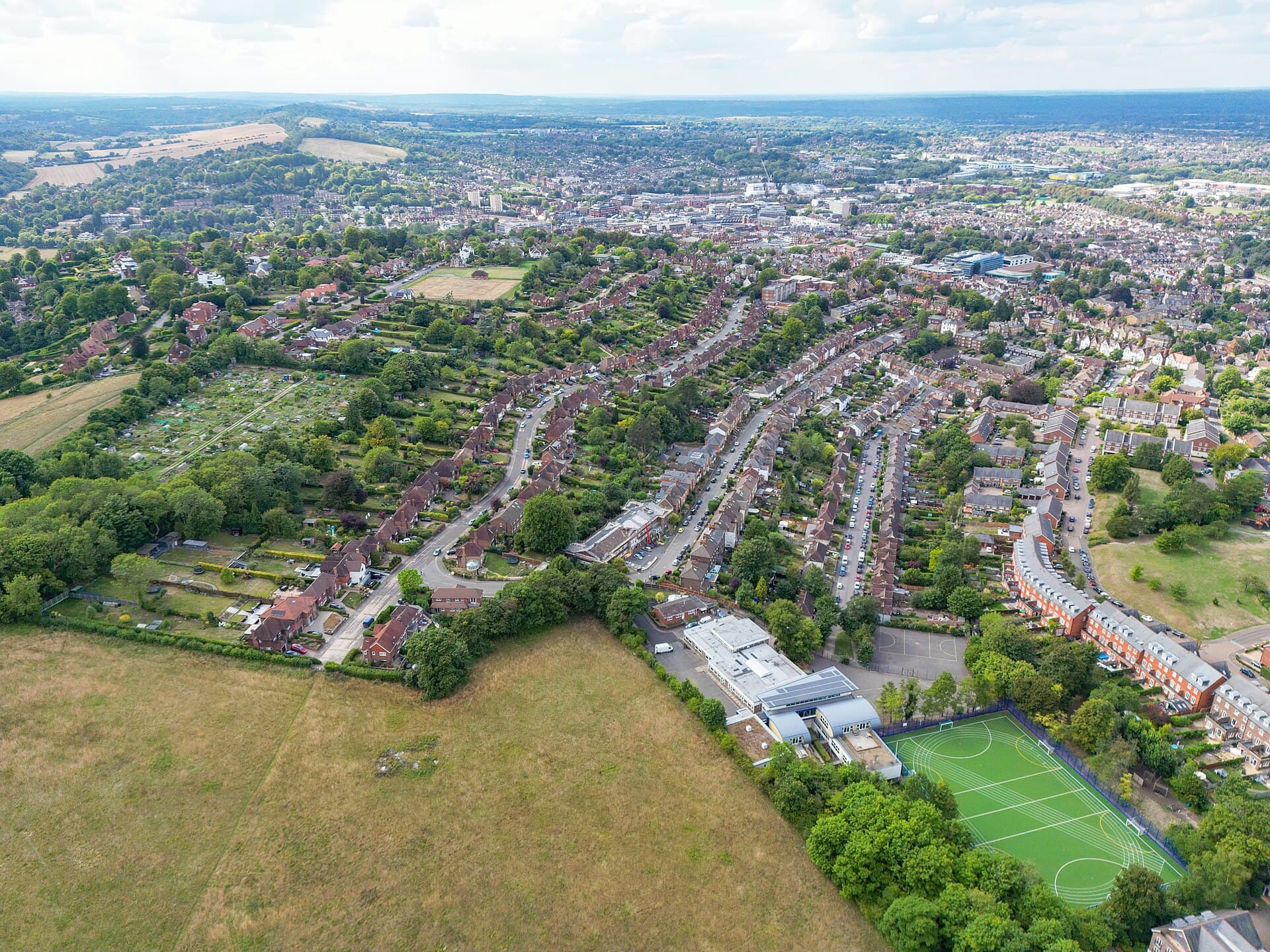
Woodlands, grasslands, lakes and rivers can create significantly cooler microclimates in cities, offering one way to reduce urban heat and protect people during extreme heat events, according to a new study conducted in Guildford, a town in southeast England.
Researchers collected temperature data from six sites — a woodland, grassland, lakeside, vegetated green wall, small pocket park and riverside — and compared each with a nearby built-up location. Sensors recorded temperatures at one-minute intervals from June 2023 through August 2025, capturing conditions during both normal weather and several extreme heat events. The team also used satellite data to validate the readings.
All six green-blue infrastructure sites were cooler by 1.81-2.49 degrees Celsius (3.26-4.48 degrees Fahrenheit) than built-up comparison areas. The cooling effect was more pronounced during extreme heat events. On the hottest days, the woodland site was upward of 6 degrees Celsius (almost 11 degrees Fahrenheit) cooler than the built environment, while the riverside and pocket park were cooler by 3.5 degrees Celsius (6.3 degrees Fahrenheit). The green wall had the least cooling effect of the six sites tested.
Vivek Shandas, a professor of geography at Portland State University who was not involved in the study, said the findings move beyond the assumption that "green is good" toward the question of how cities should be designed so cooling is available where and when people actually need it. He noted that cooling effects depend on design, scale, surrounding buildings and pavement, weather conditions and time of day.
The researchers acknowledged that their observations were based on a single site for each type of green-blue infrastructure, and local conditions could significantly influence the results. The study reflects growing urgency as the United Nations announced that global temperatures will soon surpass the climate change targets established by the 2015 Paris Agreement.