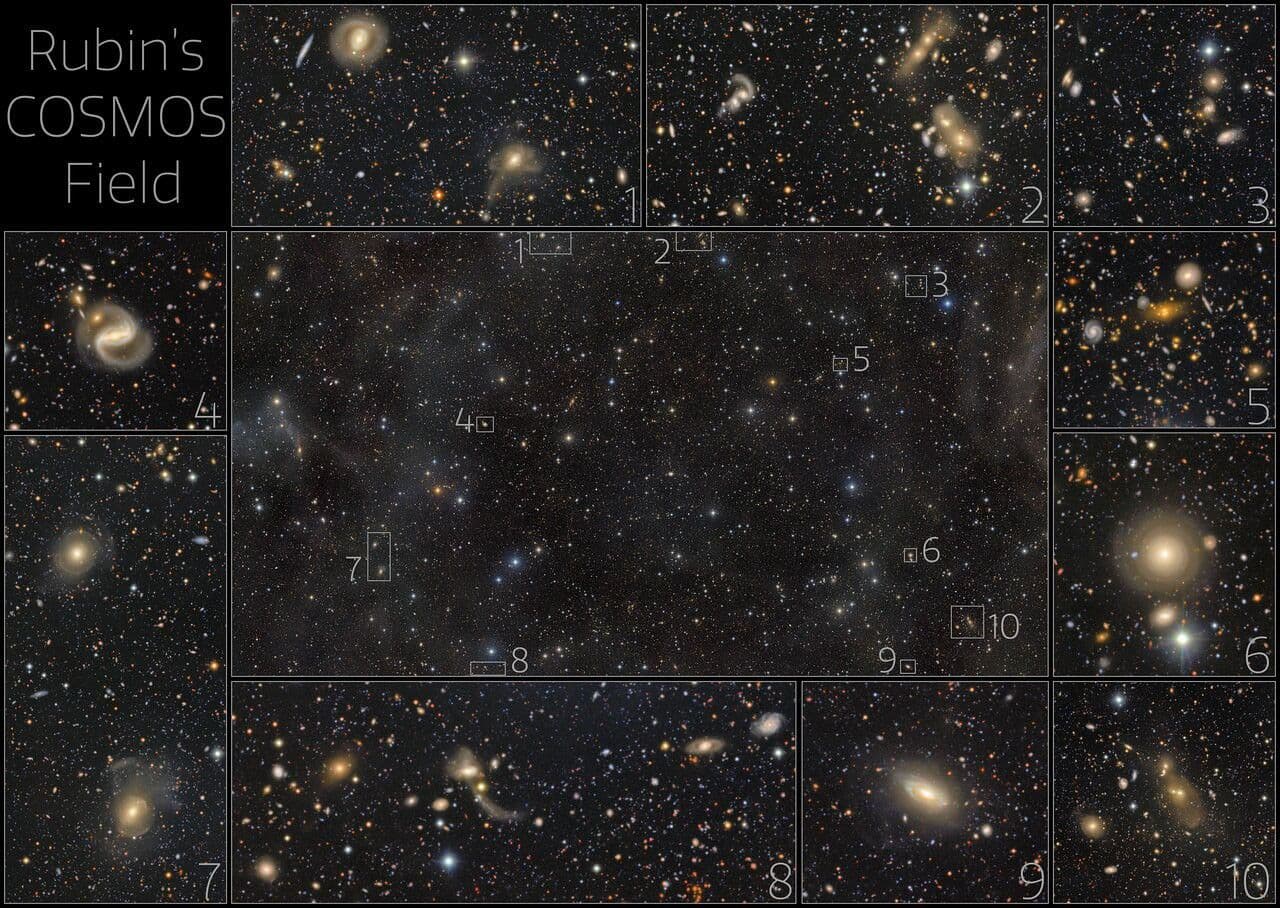
The NSF-DOE Vera C. Rubin Observatory in Chile has captured an image containing more than half a million galaxies in the COSMOS field, a region of sky several times larger than the full moon. The area was first observed by the Hubble Space Telescope and has since been studied by the Webb telescope and other observatories.
The COSMOS field is valued by astronomers for its relative lack of bright stars from the Milky Way, which provides an unobstructed view of distant galaxies beyond our own. The variety in galaxy shapes and sizes spans billions of light-years, with some galaxies so distant that their light took billions of years to reach Earth.
Rubin Observatory will return to observe the COSMOS field every couple of days as part of its ten-year Legacy Survey of Space and Time. The repeated observations will create a dynamic record of how the sky changes over time in this region.
