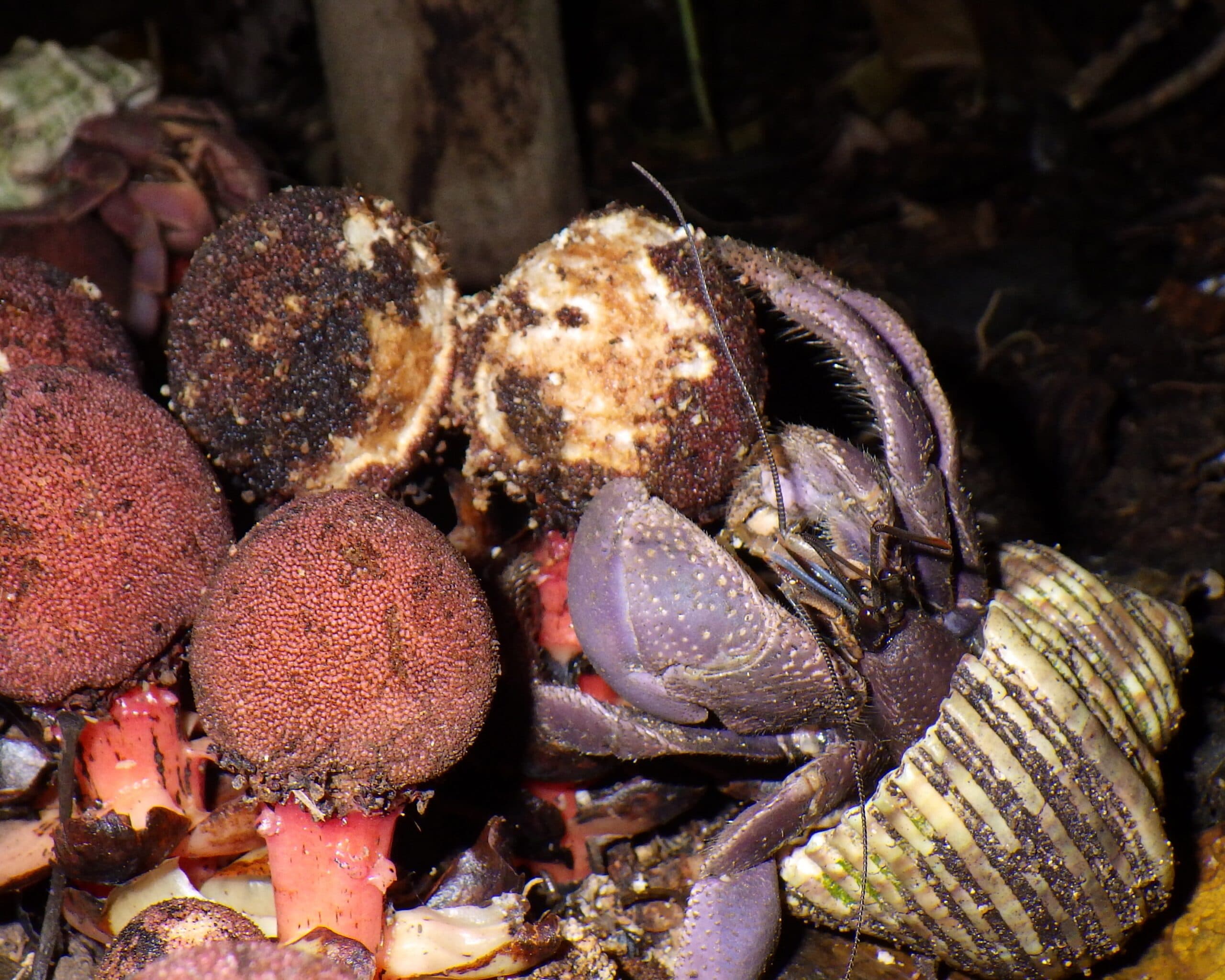
Land hermit crabs and cockroaches are the primary seed dispersers for a parasitic plant on Ishigaki Island near Okinawa, according to a recent study. The research challenges previous assumptions that gravity or ants played the main role in spreading seeds of fungus root (Balanophora fungosa), a non-photosynthetic plant that grows on tree roots across Asian and Pacific forests.
Kenji Suetsugu, a professor of biodiversity and ecology at Kobe University, initially expected ants to be the main dispersers. To test this theory, he covered some plants with mesh nets that allowed ants inside but kept larger animals out; however, the fruits remained untouched. He then set up a waterproof digital camera positioned 20 centimeters from plants, programmed to take photos every 50 seconds over nearly 89 hours. The resulting 6,427 images captured hermit crabs and cockroaches feeding on fruits primarily at night.
Land hermit crabs carried an average of 86 fruits externally on their claws and also ingested and defecated numerous intact seeds, some of which remained viable after passing through their digestive tracts. Cockroaches also defecated seeds but excreted fewer intact seeds than the hermit crabs. "To our knowledge, this is the first empirical evidence that land hermit crabs can function as both external and internal seed dispersers," Suetsugu said.
Both creatures appear drawn to the plants by a fermented odor released by mature fruits. Suetsugu noted that seed-dispersal research has traditionally focused on birds and mammals, potentially overlooking important interactions on forest floors and islands where ground-dwelling invertebrates may provide dispersal services. "The broader lesson is that familiar animals can have ecological roles that remain hidden simply because nobody has watched them closely enough," he said.