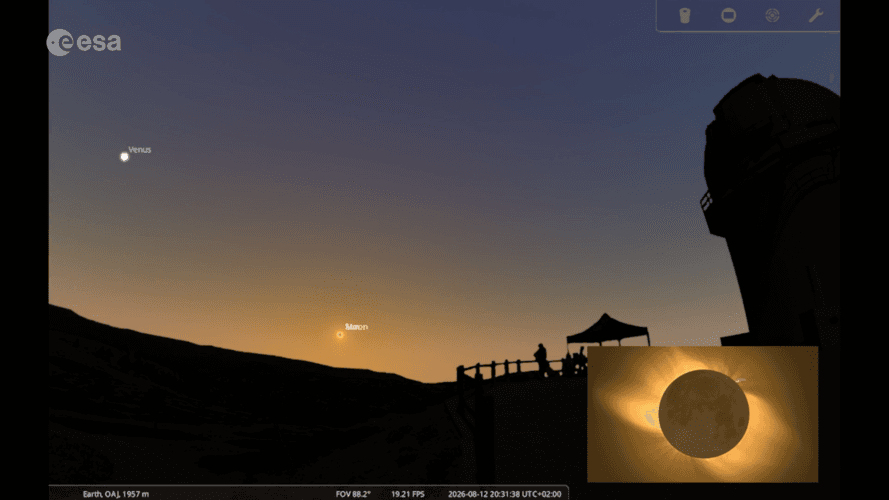
The European Space Agency's CESAR team has collaborated with Rubén García Benito of the Instituto de Astrofísica de Andalucía to create a musical simulation of the total solar eclipse expected on August 12, 2026, as viewed from the Observatorio Astrofísico de Javalambre in Spain. The project uses nine parameters extracted from a Stellarium simulation of the eclipse to map astronomical data to musical elements.
The arpeggios in the composition represent visible sunlight, with rhythm, range and volume determined by the light itself and the chord following the colour of the sky. A background pad reflects the colour of the light, growing darker as it becomes redder and warmer. The bass represents the depth of darkness, reaching its lowest point during totality.
Additional elements include a heartbeat that reflects the rate of change in light, bells that mark the four contact points of the eclipse, and a shimmering sound representing the solar corona during totality. A descending whoosh marks the moment the Sun disappears below the horizon, while a low night drone indicates the onset of night and soft sparkling tones represent stars becoming visible.
The ESA described the project as a "musification" — an artistic interpretation of data in which the eclipse determines when and how much of each sound is heard. The music serves as a means of presenting the eclipse data. The ESA is broadcasting live from the observatory during the eclipse and offers an overview of eclipse activities and resources at esa.int/solareclipse.
