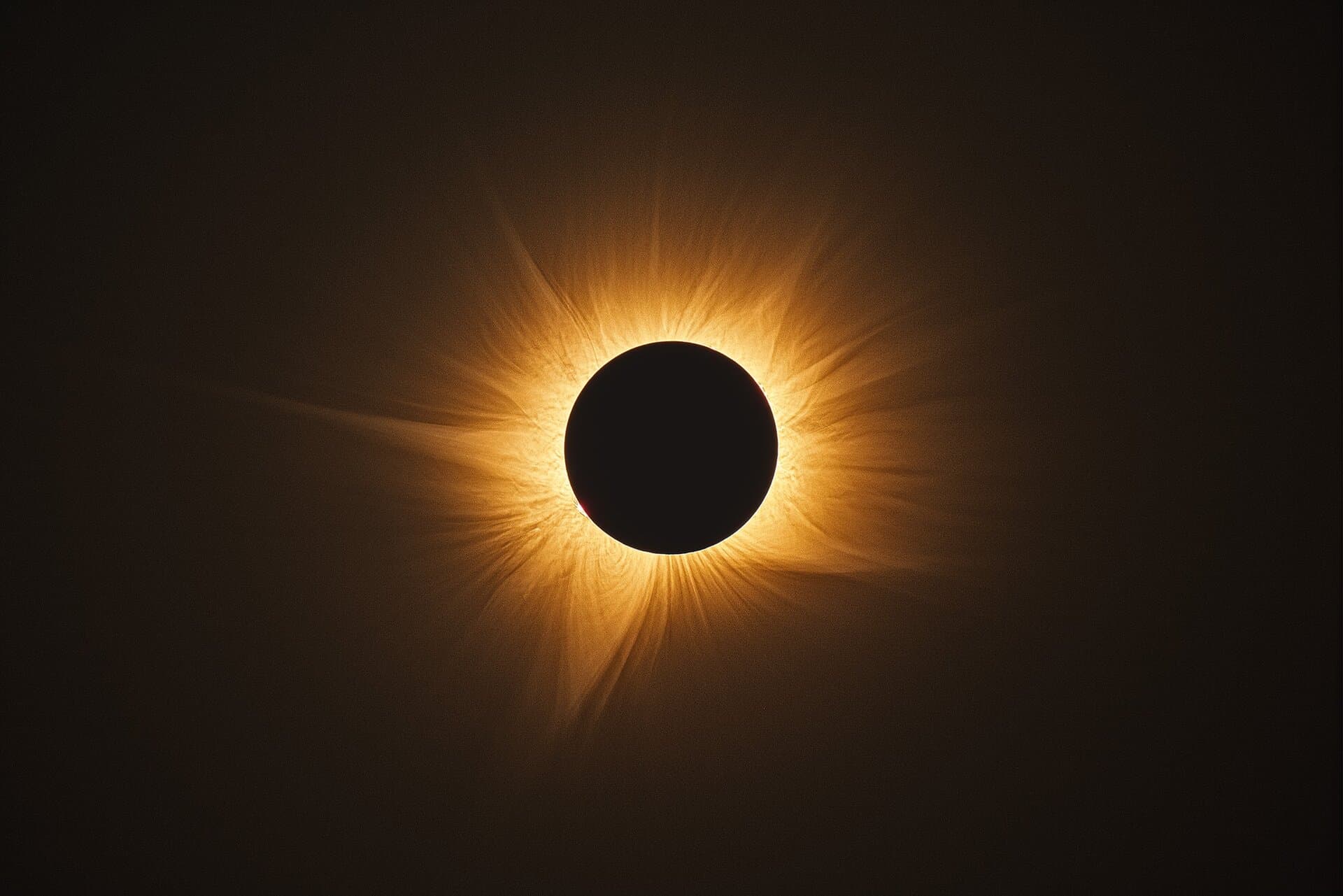
On August 12, 2026, Europe witnessed the first total solar eclipse in over two decades. Millions of people observed the Moon completely covering the Sun's bright disc, briefly turning day into night and revealing the Sun's outer atmosphere. Totality could be seen from Greenland, Iceland, Spain and Portugal, while most of the rest of Europe saw a partial eclipse.
As the Moon eclipsed more of the Sun, the light faded and temperature dropped. Shadows sharpened, and leaves on trees projected crescents on the ground. Right before the Sun's disc was entirely blocked, small beads of light appeared on the Moon's edge where sunlight passed through lunar valleys. A bright flash of light, known as the diamond ring effect, marked the beginning of totality.
In the darkness that followed, the Sun's outer atmosphere became visible. White streaks of light extended outward in all directions, and bright red, glowing prominences clung close to the Sun's surface. "The detail was incredible. This eerie, nighttime light is what it feels like, but it's not nighttime. Really very, very special," said the European Space Agency's Director of Science Professor Carole Mundell during ESA's live broadcast from the Observatorio Astrofísico de Javalambre, Spain.
The European Space Agency arranged live telescope feeds from Spanish observation sites in León, Palencia and Javalambre, while photographers across Europe shared images of the eclipse. Earth observation satellite MTG-I1 captured the Moon's shadow moving across Earth, and ESA's artificial eclipse-maker Proba-3 captured a double eclipse from orbit. ESA's broadcast, hosted by Dame Dr Maggie Aderin, allowed those unable to travel to regions of totality to experience the phenomenon alongside scientists and observatory experts.
The ESA, together with the City of León and the University of León, organised a free public event in León on the day of the eclipse. An estimated 10,000 to 12,000 people attended a daytime programme featuring hands-on workshops, experiments and interactive activities. A further 14,500 people attended the evening programme, which included science talks and expert commentary guiding visitors through each stage of the eclipse. Two more solar eclipses are expected to reach Europe in coming years: on August 2, 2027, and January 26, 2028.
