Dust and water survive near galactic black hole

An international team of astronomers using the James Webb Space Telescope discovered that dust and water can form and persist in the intense radiation environment around the Milky Way's central supermassive black hole.

Oleh Sama News Agency
18 Agustus 2026
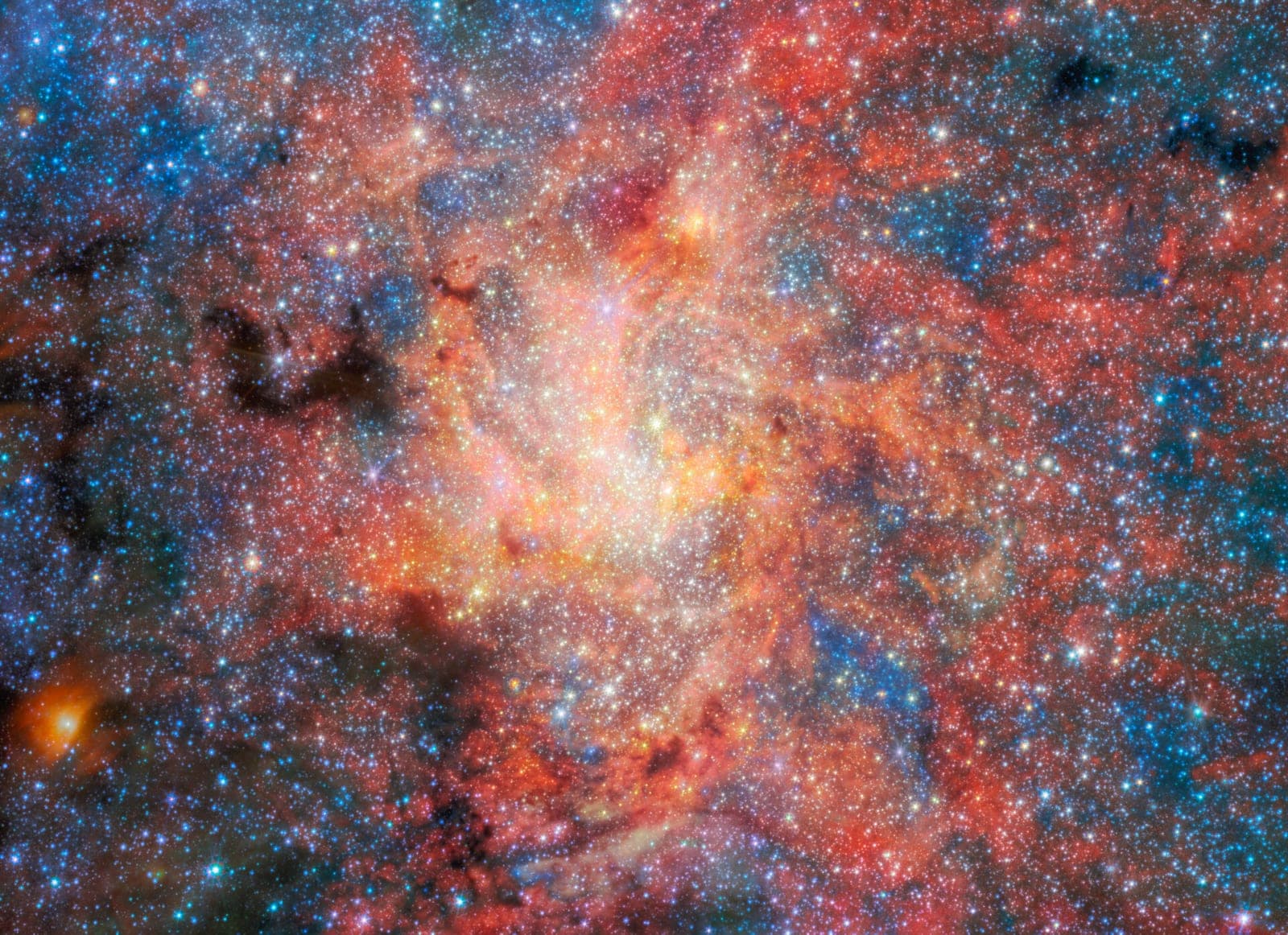
A dense field of stars in shades of blue, red, orange, and yellow, with dark dust lanes obscuring portions of the stellar background.
This infrared observation from the James Webb Space Telescope shows the densely populated region surrounding Sagittarius A*, the supermassive black hole at the center of the Milky Way. New research reveals that dust and water molecules can form and survive in this extreme radiation environment. (ESA — Space News)
1 menit membaca
Ukuran teks

An international team of astronomers has discovered that dust and water can form and survive surprisingly close to the supermassive black hole at the center of the Milky Way galaxy. The observations were made using the NASA/ESA/CSA James Webb Space Telescope.

The evolved star IRS 3 continues to enrich its surroundings with newly formed material despite the intense radiation environment around Sagittarius A*, the observations reveal.

Dust and water survive near galactic black hole | Sama News Agency