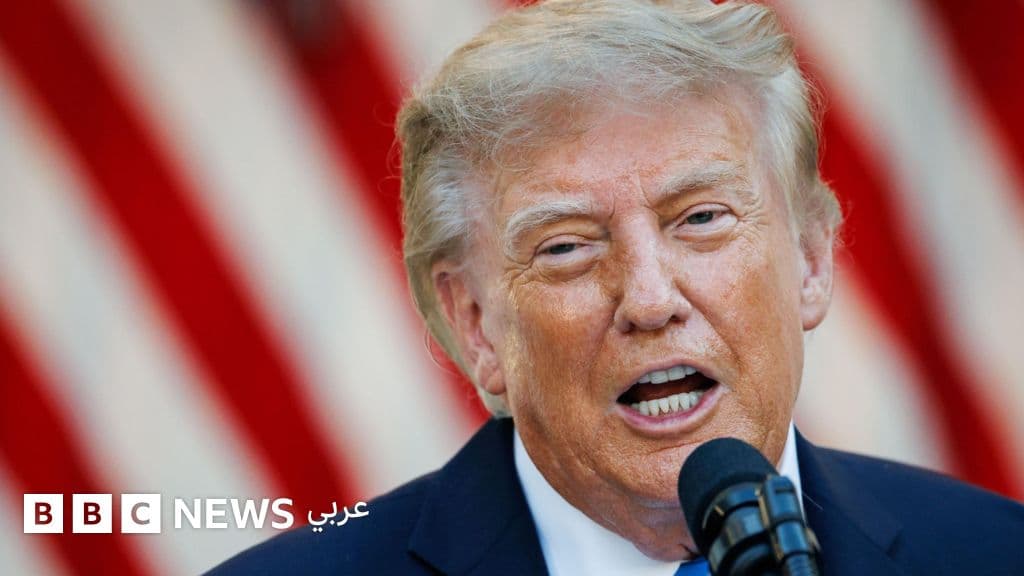
President Trump described the emerging US strategy against Iran after recent American strikes, noting that the military waited until Iranian radar equipment was nearly rebuilt before striking. "We waited until it was almost built, and then we hit it," Trump said. On Tuesday, American forces attacked several targets in Iran, with US Central Command stating that destroyed sites included air defense installations, radar systems, maritime assets, mine-laying capabilities and communications facilities.
US officials indicated they were considering a strategy of limited strikes at regular intervals to prevent Iran from reconstituting military capabilities in the Strait of Hormuz, according to news reports. An American government representative described the approach as "mowing the grass," a concept borrowed from Israeli security policy. The strategy does not aim to permanently defeat an opponent but rather to regularly reduce military capabilities to manageable levels, with renewed strikes when those capabilities rebuild.
The approach faces significant constraints. Iranian military technology knowledge and industrial capacity would survive targeted strikes, meaning reconstruction can be delayed but not prevented. Mona Yacoubian, director of the Middle East program at the Center for Strategic and International Studies in Washington, warned in April that this could lead to an "enduring low-intensity conflict punctuated by more intensive interventions." She noted that Israeli academics who developed the strategy cautioned that if an opponent had "statist characteristics and/or more powerful capabilities, 'mowing the grass' might become an outdated military strategy."
The US has limited control over Iranian responses to American attacks. This week, when Trump warned Iran against retaliation, threatening it would be "totally wiped out as a country" if it did, Tehran immediately fired missiles against American facilities in the region. Yacoubian warned that repeated American attacks could lead Tehran to conclude that "pursuit of a nuclear weapon" is the only means to achieve "lasting deterrence," potentially accelerating the nuclear development the strikes aim to prevent.
For Trump, the strategy offers political advantages, allowing him to distance himself from the "forever wars" he criticized his predecessors for pursuing while avoiding occupation, nation-building and large-scale deployment of ground troops. However, Yacoubian described the approach as a "Sisyphean attrition strategy without end," noting that without Washington accepting Iran's military rebuilding, each successful strike merely justifies the next.