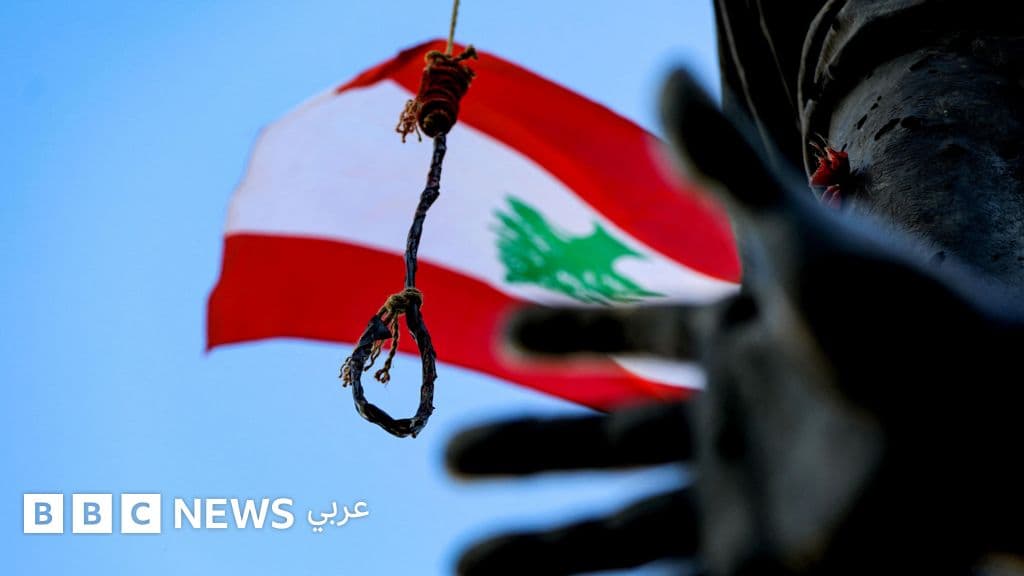
Lebanon's parliament approved legislation abolishing capital punishment from Lebanese law on Tuesday, more than 22 years after the last execution was carried out in the country.
The death penalty will be replaced with life imprisonment, with harsher sentences for crimes committed after the law comes into force, in a move described by the Ministry of Justice as "the culmination of a firm justice path that protects human rights". Human rights organisations welcomed the decision, though the formulation of the replacement sentence triggered legal objections, and members of parliament from the Hezbollah bloc opposed it.
After completion of the ratification procedures and publication, Lebanon will become the first country in the Middle East and the second Arab country to abolish capital punishment, following Djibouti which abolished it in 1995, according to human rights organisation classifications.
Lebanon's parliament approved the legislation with a majority vote after making amendments, without announcing detailed voting results. The "Loyalty to Resistance" bloc linked to Hezbollah objected to the law, though the bloc had not issued a statement explaining the reasons for its position at the time this report was prepared.
The Ministry of Justice said in a statement following the vote that abolishing capital punishment does not mean "tolerance of serious crimes" or a reduction of the rights of victims and their families, considering that the harsher replacement sentence ensures accountability and public protection without maintaining a punishment whose consequences cannot be undone if investigation, evidence, or trial errors are later proven.
The ministry added that "the power of justice is not measured by its ability to end the lives of the accused", but by its ability to uncover the truth, satisfy victims, and punish perpetrators within the framework of guarantees of the rule of law.
Lebanon effectively ceased carrying out capital punishment from 17 January 2004, while the sentence remained in law, and courts continued to issue death sentences. With the passage of the legislation and completion of the ratification procedures and publication, Lebanon is transitioning from a de facto cessation of executions to legislative abolition.
According to the latest data from the Prison Directorate at the Ministry of Justice cited by the National Human Rights Institution, eighty-five people have been sentenced to death in Lebanon through the end of 2025, as courts, particularly military courts, continued to issue death sentences during the years of the execution moratorium.
The version approved by the combined parliamentary commissions provided for the abolition of capital punishment "wherever stipulated in Lebanese law", and its replacement with "aggravated life hard labour", with the removal of articles regulating the procedures for its implementation.
However, parliament members approved an amendment proposed by deputy Abdur Rahman al-Bizri during the session, which distinguished between crimes committed before the law comes into force and those occurring after it. According to the version announced in the parliament, the death penalty for previous crimes is replaced with life hard labour, while the punishment for crimes after is "aggravated life hard labour".
The term "aggravated" triggered objections from parliament member Nabil Badr, who said this punishment is not regulated in criminal law, and that parliament had thus "created a new punishment". Conversely, parliament member Milhem Khalaf said that abolishing capital punishment requires the application of a replacement sentence for the most serious crimes.
Human rights institutions also favoured the continuation of hard labour sentences. The National Human Rights Institution said this is based on a concept that is no longer in line with modern human rights standards, and called for its replacement with punishments that restrict liberty while considering accountability, rehabilitation, and the dignity of prisoners.
Human Rights Watch noted that hard labour, although appearing in Lebanese court sentences, is rarely implemented in practice due to lack of capacity and infrastructure required in prisons. Therefore, determining the meaning of "aggravated life hard labour" and the mechanisms for its implementation remain issues that may require legislative or judicial interpretation.
The final amended text has not been officially published at the time of this report's preparation, making the precise effect of the amendments on current prisoners dependent on the final version of the legislation.
An organised campaign to abolish capital punishment in Lebanon began in 1997, when nonviolent activist and thinker Walid Saliba and researcher Agharat Yunan launched a national campaign to eliminate the sentence.
This occurred following a period in which Lebanon tended to harden sentences after the civil war. In 1994, parliament passed Law Number 302, which restricted judges' ability to provide reasons for leniency in certain murder crimes, before this strictness was removed in 2001, restoring courts with a broader margin in determining sentences.
The last execution in Lebanon was carried out in the early hours of 17 January 2004, against Ahmad Ali Mansur by hanging, and Badih Hamadah and Rami Za'tar by shooting. Since then, successive governments halted the completion of execution procedures, which require consideration by an amnesty committee, presidential approval, and the issuance of a decree for execution.
Subsequent attempts to abolish the sentence legislatively followed. Bills were submitted in 2004 and 2012, and the Ministry of Justice prepared a draft in 2014, but none reached a final vote.
The current bill was drafted by the Lebanese Institution for Civil Rights, and registered in parliament on 7 October 2025, signed by seven parliament members: Elias Hanakish, Osama Saad, Paula Yacoubian, George Akis, Faisal al-Sayyigh, Halimah al-Qa'qour, and Michel al-Doueihi.
The bill's drafters named it "Walid Saliba Law", as a tribute to one of the main pioneers of the anti-capital punishment campaign. The bill received support from the Council of Ministers in November 2025, before being approved by the human rights commission in February, then the administrative and justice commission, and the combined parliamentary commissions in July 2026.
Capital punishment is regulated in a number of Lebanese laws, including criminal law, military criminal law, and special regulations. The cessation of its implementation since 2004 did not prevent courts from continuing to issue death sentences, and does not constitute a legal guarantee to prevent its resumption in the future.
The Ministry of Justice said that abolishing the sentence aligns with Lebanon's commitments regarding the right to life and human dignity and guarantees of fair trials. Lebanon has chosen to support United Nations General Assembly resolutions in 2020, 2022, and 2024 urging the cessation of capital punishment as a step towards its abolition.
The abolition also has implications for international judicial cooperation, as countries that have abolished capital punishment in many cases refuse to extradite persons sought to countries where they might face this sentence, or require guarantees that it will not be sought or carried out. The Ministry of Justice considers that abolishing capital punishment from Lebanese law can remove obstacles encountered in some extradition requests from abroad.
Regarding deterrent effects, the ministry said comparative studies have not proven that capital punishment achieves a certain deterrent effect beyond long and severe sentences, considering that deterrent effectiveness relates to the speed of investigation and trial, judicial independence, and certainty of accountability, not merely the severity of the sentence.
If the legislation is passed and published in the version announced, Lebanon will become the first country in the Middle East to abolish capital punishment for all crimes, and the second Arab country after Djibouti to abolish it in 1995.